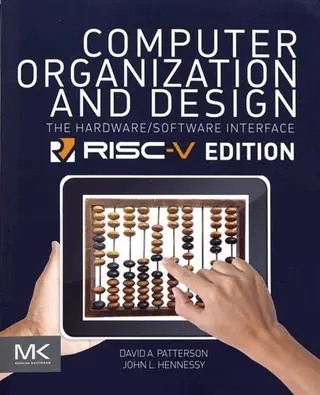
Computer Organization and Design RISC-V Edition
by David A. Patterson, John L. Hennessy · first published 2017
10mentions
6recommended by
10HN commenters
2019–2025first – last mentioned
60% recommend30% neutral10% critical
Why HN recommends it
Introduction to where hardware and software meet, covering processor organization, assembly, and the interface between them; a starting point for engineers and students who want to see what runs beneath code.
Summarised by Claude from recommending comments
Affiliate links. As an Amazon Associate I earn from qualifying purchases.
Mentions per year
What Hacker News says
Related books
 2010–2026
Digital Design and Computer Architecture
Sarah Harris, David Money Harris
Recommended by 26 · mentioned by 3626 recommend · 36 mention26 recommend · 3626 recommend
 2017–2026
Crafting Interpreters
Robert Nystrom
Recommended by 295 · mentioned by 397295 recommend · 397 mention295 recommend · 397295 recommend
Maybe this book: Computer Organization and Design - RISC-V Edition ? On Amazon: https://www.amazon.co.uk/Computer-Organization-Design-RISC-V...
on “Show HN: IDE for Learning RISC-V” ↗…than the compiler. Assembly is just a way to write it down. There are two recently updated great books I recommend: - Computer Architecture: A Quantitative Approach (2017) by Hennessy & Patterson - Computer Organization and Design - RISC-V Edition (2017) by Hennessy & Patterson (I have the older MIPS edition) You also need a book and documentation for the specific architecture (x86 or ARM), but the two books above teach generic stuff that is…
on “Ask HN: Resources for getting started with bare-metal coding?” ↗Computer Organization and Design RISC-V Edition: The Hardware Software Interface (2nd Edition) by David A. Patterson and John L. Hennessy
on “Ask HN: What are the best tech books you read in 2021?” ↗Love the Harris and Harris book! I might add these: - Computer Architecture, Fifth Edition: A Quantitative Approach - https://dl.acm.org/doi/book/10.5555/1999263 - Computer Organization and Design RISC-V Edition: The Hardware Software Interface - https://dl.acm.org/doi/10.5555/3153875 both by Patterson and Hennessy Edit: And if you want to get into CPU design and can get a grip on "Advanced Computer Architecture:…
on “Tiny GPU: A minimal GPU implementation in Verilog” ↗And on a semi-related note, Patterson and Hennessy's "Computer Organization and Design (RISC-V Edition)" is an updated classic introduction to computer architecture (and its sequel is legendary.) I also recently discovered Harris and Harris' Digital Design and Computer Architecture (RISC-V Edition), and…
on “Verilator: Open-Source SystemVerilog simulator and lint system” ↗…compiler) and write your own simple functions. Then put the original function and the assembly output into an LLM prompt window and ask for a line-by-line explanation. Also very useful to get a copy of Computer Organization and Design RISC-V Edition: The Hardware Software Interface, by Patterson and Hennessy.
on “Addressing the adding situation” ↗The author talks about "Computer Organization and Design, RISC-V Edition". Is the book worth a read even if one read the other (and older) edition of the Patterson book? Can I sufficently learn RISC-V from it, or is it used as mere "reference" architecture?
on “Build a RISC-V CPU from scratch” ↗I've been going through the Computer Organization and Design - RISC V edition textbook by David Patterson and Hennessy by myself. I've half done - 3/6 chapters and have kept a list of errata the book contains, mostly slight discrepancies, but sometimes, pretty horrendous ones.…
on “Finding way too many mistakes in Hennessy-Patterson” ↗…that my background knowledge is clear: I've concluded NAND2TETRIS, watched and concluded Berkeley's 2020 CS61C and have read a good chunk of H&P (both Computer Architecture: A Quantitative Approach and Computer Organization and Design: RISC-V edition), and now am moving on to Onur Mutlu's lectures on advanced computer architecture.
on “Ask HN: How does a CPU communicate with a GPU?” ↗> Is there any published rationale for the RISC-V instruction encoding? Computer Organization and Design, RISC-V edition, goes into these. R-types have opcode = 0b0110011, SB (branch) types have opcode = 0b1100011, etc. The lower bits also have extra meanings (16 bit, 48 bit, etc. instruction). This allows hardware to…
on “ULX3S: Hackable FPGA that runs Linux on RISC-V” ↗