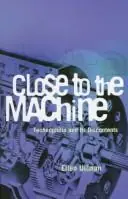
Close to the Machine
by Ellen Ullman · first published 1997
71% recommend29% neutral
Why HN recommends it
Traces a software developer's working life through the 1990s dot-com era, offering a vivid, reflective account of programming culture. Suited to developers and anyone curious about the human side of technology.
Summarised by Claude from recommending comments
Here is a candid account of the life of a software engineer who runs her own computer consulting business out of a live-work loft in San Francisco's Multimedia Gulch. Immersed in the abstract world of information, algorithms, and networks, she would like to give in to the seductions of the programmer's world, where "weird logic dreamers" like herself live "close to the machine." Still, she is keenly aware that body and soul are not mechanical: desire, love, and the need to communicate face to face don't easily fit into lines of code or clicks in a Web browser. At every turn, she finds she can
Affiliate links. As an Amazon Associate I earn from qualifying purchases.
Mentions per year
What Hacker News says
Related books
Nudist on the Late Shift
Po Bronson
Recommended by 6 · mentioned by 86 recommend · 8 mention6 recommend · 86 recommend
 2017–2026
Life in code
Ellen Ullman
Recommended by 4 · mentioned by 114 recommend · 11 mention4 recommend · 114 recommend
 2017–2023
Dawn of the new everything
Jaron Lanier
Recommended by 8 · mentioned by 98 recommend · 9 mention8 recommend · 98 recommend
 2010–2025
The Bug
Ellen Ullman
Recommended by 12 · mentioned by 1412 recommend · 14 mention12 recommend · 1412 recommend
 2007–2026
High stakes, no prisoners
Charles H. Ferguson
Recommended by 18 · mentioned by 2118 recommend · 21 mention18 recommend · 2118 recommend
 2010–2026
Computer Power and Human Reason
Joseph Weizenbaum
Recommended by 14 · mentioned by 3014 recommend · 30 mention14 recommend · 3014 recommend
 2007–2026
A Book of Five Rings
Miyamoto Musashi
Recommended by 21 · mentioned by 5021 recommend · 50 mention21 recommend · 5021 recommend
 2010–2026
Racing the Beam
Nick Montfort, Ian Bogost
Recommended by 39 · mentioned by 4839 recommend · 48 mention39 recommend · 4839 recommend
…digital space — from punchcards to touch screens. I'm looking for books that capture that dichotomy. Ellen Ullman is one of the few non-explicitly geek-facing fiction writers that easily comes to mind (Close to the Machine [0]). As are parts of The Information [1] (Turing machine construction, for ex ...). Beautiful Code [2] is yet another, but skewing a bit too technical ... A friend recommended grabbing computer instruction…
on “Ask HN: Best books (fiction?) written about *real* computers/computing.” ↗> What other similar books would you recommend? "Close to the Machine" by Ellen Ullman and "Microserfs" by Douglas Coupland occupy roughly the same space in my memory.
on “Ellen Ullman wrote the most precise account of “computer culture” I have seen” ↗The author of this piece, Ellen Ullman, wrote a really great book (IMHO) called "Close to the Machine" back in 1997; I'm not sure, but I think some of the book was based on a series of (very early) Salon.com essays. Besides being a thoroughly enjoyable nostalgia trip back to the original dotcom bubble,…
on “This American Life's obituary for Dennis Ritchie” ↗…involvements. "Masters of Doom" by David Kushner chronicles the history of id Software and its creators. It's an entertaining book for sure, especially the part where id has Gwar show up at Microsoft. "Close to the Machine" by Ellen Ullman is the memoir of a software developer in the 80s. I need to read this one again, but it was enjoyable. I think about one part in particular from time to time where the author recounts…
on “Ask HN: Computer Science/History Books?” ↗I studied English alongside CS and was really into the creative nonfiction genre in my university days. I remember really enjoying "Close to the Machine" by Ullman, might be worth checking out.
on “Ellen Ullman: We Have to Demystify Code (2017)” ↗Things like this are (sadly) common (and age-old) problems with automation and computerization. (For a vivid account of this phenomenon, check out the novel _Close to the Machine_, by Ellen Ullman.) As executives and analysts increasingly use the "AI" craze to push automation and computerization (and layoffs) generally, even aside from AI proper, it should not be surprising that…
on “Kaiser nurses say AI, workplace surveillance are making their jobs, care worse” ↗Well, not so much as new releases, except for one. But this year I really enjoyed: Reamde by Neil Stephenson (Can't get enough of that guy) The Art of Deception by Kevin Mitnick Close to the Machine by Ellen Ullman
on “Ask HN: Best books you read in 2012” ↗'Close to the Machine' by Ellen Ullmann - a memoir about the 90s in SF and SV by a software engineer, a different view of same time, place, and kinds of people as in the Ferguson book. Also her novel 'The Bug', a fictional…
on “Ask HN: What are some good books on SV / Tech industry history?” ↗…difficulty of life as a developer. I don't have many recommendations to explain or explore The Most Important Life Aspect Of Being A Programmer, which you've so very really captured imo. Ellen Ullman's Close To the Machine (`97) is a relatively-early memoire that has some very nice capturances of this weird world, of the life of being a machine-speaker, a truth-finder, apart from the rest of the adrift weird world. Haven't…
on “Ask HN: Year old CS student. Should I continue?” ↗I recently read Ellen Ullman's memoir about her life as a software developer in the dot-com bubble era: "Close to the machine: Technophilia and its discontents". The book was written before I was born, but I can still closely relate to most of the cultural points made. She does a great job defining the anxieties and frictions…
on “Ellen Ullman wrote the most precise account of “computer culture” I have seen” ↗Close to the Machine: Technophilia and Its Discontents https://www.amazon.com/Close-Machine-Technophilia-Its-Discon...
on “Ellen Ullman wrote the most precise account of “computer culture” I have seen” ↗Close to the machine by Ellen Ullman
on “Ask HN: What's the best book on the early history of the Internet and/or Web?” ↗…can be, what the internet means, and are so inspired by having help with the labor of building. But these stories these feelings: they are gonna be crushed. It's not a tale that's easy to tell. Those "Close to the Machine" (Ullman) live a weird life if having these deep connections & intimacy with systems, that are so sweepingly powerful, but man, it is such an alien world to most, and trying to tell these stories, trying…
on “An AI Hate Wave Is Here” ↗…to being smart. This isn't about mastering some difficult algorithm and then implementing it in python or ruby instead of java. There are a lot of idiosyncrasies. I remember Ellen Ullman (she wrote "Close to the Machine", a reflection on programming before these types of books were so common) described programmers as "serial monogomists", becoming very loyal to their environments for a while, then abandoning them and…
on “PHP needs to die. What will replace it?” ↗…ideal. And isn't this working towards an ideal just a love affair? One might claim that programming is logic-intensive compared to the spiritual life and other disciplines like poetry. Ellen Ullman in Close to the Machine: Technophilia and its Discontents writes, "...the computer is... a projection of a very slim part of ourselves: that portion devoted to logic, order, rule, and clarity." Another form of the author's question…
on “How can you not be romantic about programming? (2020)” ↗