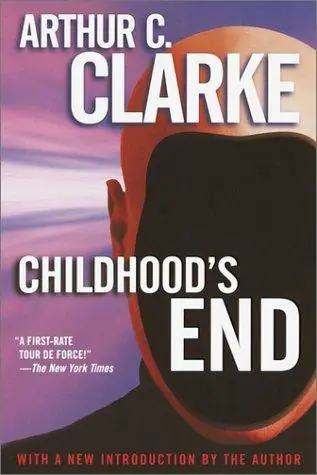
Childhood’s End
by Arthur C. Clarke · first published 1952
56% recommend41% neutral3% critical
Why HN recommends it
Sci-fi novel about benevolent aliens bringing peace and a utopia with hidden costs. Admired for its sweeping time scale, emotional impact, and unsettling questions about what a effortless, comfortable humanity loses.
Summarised by Claude from recommending comments
Childhood's End is a 1953 science fiction novel by British author Arthur C. Clarke. The story follows the peaceful alien invasion of Earth by the mysterious Overlords, whose arrival ends all war, helps form a world government, and turns the planet into a near-utopia. Many questions are asked about the origins and mission of the aliens, but they avoid answering, preferring to remain in their ships, governing through indirect rule. Decades later, the Overlords eventually show themselves, and their impact on human culture leads to a Golden Age. However, the last generation of children on Earth be
Affiliate links. As an Amazon Associate I earn from qualifying purchases.
Mentions per year
What Hacker News says
Related books
 2013–2024
A Case of Conscience
James Blish
Recommended by 2 · mentioned by 32 recommend · 3 mention2 recommend · 32 recommend
 2011–2024
Lilith’s Brood
Octavia E. Butler
Recommended by 8 · mentioned by 88 recommend · 8 mention8 recommend · 88 recommend
 2009–2026
The City and the Stars
Arthur C. Clarke
Recommended by 22 · mentioned by 3822 recommend · 38 mention22 recommend · 3822 recommend
 2007–2025
The Fountains of Paradise
Arthur C. Clarke
Recommended by 12 · mentioned by 2312 recommend · 23 mention12 recommend · 2312 recommend
 2011–2020
Her Smoke Rose Up Forever
James Tiptree, Jr.
Recommended by 2 · mentioned by 22 recommend · 2 mention2 recommend · 22 recommend
 2008–2026
Rendezvous with Rama
Arthur C. Clarke
Recommended by 51 · mentioned by 9651 recommend · 96 mention51 recommend · 9651 recommend
 2008–2026
Lord of Light
Roger Zelazny
Recommended by 37 · mentioned by 4437 recommend · 44 mention37 recommend · 4437 recommend
 2016–2023
Luna
Ian McDonald
Recommended by 2 · mentioned by 32 recommend · 3 mention2 recommend · 32 recommend
The first third of Seveneves is a real gut punch. The only other world-ending story that comes close in terms of emotional impact for me was Arthur C. Clarke's "Childhood's End". Stephenson manages to show humanity in all its realistic messiness but still leave you proud -- on balance -- that humans mostly get our act together in a desperate attempt to preserve a seed of life…
on “The Day the Moon Blew Up” ↗…- Dead Wake - Man's Search for Meaning - Evicted - The New Jim Crow - Night Sci-fi: - We - The Sirens of Titan - Hyperion - Stories of Your Life - Frankenstein - The Day of the Triffids - Childhood's End Fantasy: - The Stormlight Archives - The First Law Trilogy - The Lord of the Rings Literature: - The Stranger - Dubliners - Things I've Learned from Dying - The Things They Carried - Cloud Atlas…
on “Ask HN: Which non-programming books are a beneficial read for programmers?” ↗Arthur Clarke's Childhood's End would be my recommendation though I'm not sure how it falls into the comp-fi genre.
on “Hard comp-fi reading list” ↗…On Fire" Also, the original "Planet Of The Apes". I almost forgot -- at least one Aldiss. My fave is "Report On Probability A", but it's an acquired taste. [edit -- no Arthur C. Clarke? Not even "Childhood's End"?]
on “The Amazing Colossal Science Fiction Ketchup” ↗…credit. Maybe part of it is not being in the Western European writer's camp? At any rate, I would say: Moon is a Harsh Mistress, Heinlein The Dispossessed, Le Guin The Stars My Destination, Bester Childhood's End, Clarke Stand out as some of my favorites. I'm pretty terrible at making top-5 lists, but those stand out as ones that I would read again in a heartbeat if there weren't already 50 books on the floor…
on “What are your favourite sci-fi books?” ↗…Mistress (Heinlein) Stranger in a Strange Land (Heinlein) Starship Troopers (Heinlein) A Scanner Darkly (Dick) Do Androids Dream of Electric Sheep? (Dick) The Hitchhiker's Guide to the Galaxy (Adams) Childhood's End (Clarke) Robot series (Asimov) Bicentennial Man (Asimov) Brave New World (Huxley)
on “Ask HN: What are your favorite sci-fi books?” ↗Childhood's End by Arthur C. Clarke.
on “Ask HN: Great nontech book that you read recently?” ↗My favorites: Childhood's End by Clarke: http://en.wikipedia.org/wiki/Childhood%27s_End Foundation series by Asimov: http://en.wikipedia.org/wiki/The_Foundation_Series City by Simak: http://en.wikipedia.org/wiki/City_(Clifford_D._Simak_novel)
on “Ask YC: What's the most inspiring sci-fi book you've read?” ↗…way bricks don't." Dune - what does scarcity do to a society? Isaac Asimov - Robot series. Foundation series. All of his short stories, esp. The Last Question, Nightfall. A.C. Clarke - 2001 - series, Childhood's End, The Fountains of Paradise The Little Prince, The Count of Monte Cristo, Catch-22, Siddhartha, Ender's Game, Sundiver, Wodehouse.
on “Ask HN: Good books?” ↗The theme and mood remind me somewhat of Childhood's End by Arthur C. Clarke - one of my favorite books.
on “The Egg” ↗Some iconic science fiction books that can stand alone: Asimov: The Gods Themselves Clarke: Childhood's End, Rendezvous with Rama Herbert: Dune, Whipping Star Bradbury: Fahrenheit 451 Bester: The Demolished Man, The Stars My Destination (also called "Tiger, Tiger") Niven: Ringworld Niven…
on “Beginnings of Science Fiction” ↗Since the OP asked about books not authors my favourite book is "Foundation and Earth" (Isaac Asimov), "Childhood's End" (A.C. Clarke) and Solaris (Stainslaw Lem).
on “What are your favourite sci-fi books?” ↗It's a great reading list, but I was also surprised not to find Arthur C. Clarke's "Childhood's End" in there. I had always assumed his song "Oh! You Pretty Things" was about that book. While the book and the song share themes, they are apparently independent. I did like this passage I found online…
on “David Bowie’s Top 100 Books (2013)” ↗Childhood's End, Arthur C. Clarke. Space travel is sub-light speed, and specifically takes account of time dilation as an integral part of telling the story.
on “NASA admits it doesn’t have the funding to land humans on Mars” ↗Arthur Clarke's Childhood's end. I know it's fiction but it left me speechless. And aside from the descriptions of technology foreseen at that it was written, I think it's timeless. “No utopia can ever give satisfaction to everyone,…
on “Ask HN: What books changed the way you think about almost everything?” ↗