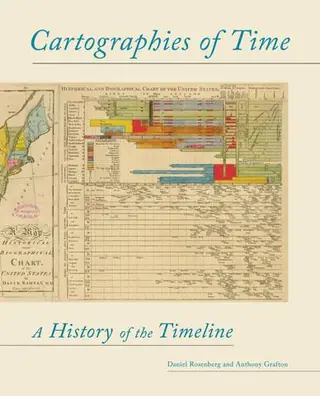
Cartographies of time
by Daniel Rosenberg, Anthony Grafton · first published 2009
3mentions
3recommended by
3HN commenters
2021–2024first – last mentioned
100% recommend
What does history look like? How do you draw time? From the most ancient images to the contemporary, the line has served as the central figure in the representation of time. The linear metaphor is ubiquitous in everyday visual representations of time—in almanacs, calendars, charts, and graphs of all sorts. Even our everyday speech is filled with talk of time having a "before" and an "after" or being "long" and "short." The timeline is such a familiar part of our mental furniture that it is sometimes hard to remember that we invented it in the first place. And yet, in its modern form, the
Affiliate links. As an Amazon Associate I earn from qualifying purchases.
For those interested in the history of such history maps, I can highly recommend the book of Daniel Rosenberg and Anthony Grafton: "Cartographies of Time: A History of the Timeline", Princeton Architectural Press 2012. Unfortunately it seems to be out of print, but you might be able to get hold of a second-hand copy. . -- A German translation under the…
on “Histomap: Visualizing the 4000 year history of global power (2021)” ↗Nicely done! I've been wanting to build something similar, but as a tool to assist in my history studies. Oh, and if you are into timelines and their history, you might enjoy Cartographies of Time: A History of the Timeline by Daniel Rosenberg and Anthony Grafton. Very informative read!
on “Joseph Priestley created revolutionary "maps" of time” ↗For timelines, the book "Cartographies of Time" [0] has lots of historical examples. There is also a recent presentation of the design space of timelines in "Timelines Revisited: A Design Space and Considerations for Expressive Storytelling" [1,…
on “Data Visualization and the Modern Imagination” ↗