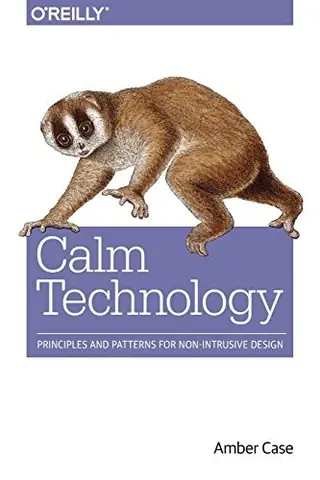
Calm Technology
by Amber Case · first published 2016
11mentions
6recommended by
10HN commenters
2016–2026first – last mentioned
60% recommend40% neutral
Why HN recommends it
Practical guidelines for designing technology that stays in the background and doesn't demand constant attention, covering notifications and maintenance. Useful for designers and engineers, including home automation.
Summarised by Claude from recommending comments
Affiliate links. As an Amazon Associate I earn from qualifying purchases.
…whole core? Or are you getting forkbombed by thousands of little ones? Those look really different. The definitive works on Calm Computing are a paper written by Mark Weiser (RIP) in 1996, "Designing Calm Technology" (which has unfortunately fallen off the internet) and an O'Reilly book called "Calm Technology" by Amber Case (the Cyborg Anthropologist) Ideally we'd go calmer than a "status light" or "status tone"…
on “Calm Technology” ↗>> "start small and focused" I'd even go as far you say, use an existing platform like Amazon's Alexa with their hardware to start. Reading a books like "Calm Technology" and books on lean startups would be good too. Books: http://www.amazon.com/Calm-Technology-Principles-Patterns-No... http://www.amazon.com/Running-Lean-Iterate-Works-OReilly/dp/...
on “Ask HN: What are the challenges of building a personal assistant like Siri?” ↗This is an aspect of a very important movement that started with Calm Technology. Think it will be the next step in gaining control of the genie from the bottle. [1] https://calmtech.com/ [2] https://www.amazon.com/Calm-Technology-Principles-Patterns-N...
on “iOS 15 Humane” ↗After a recent thread here on HN, I read the book "Calm Technology" by Amber Case. For those designing their own home automation systems, it provides nice guidelines on how to design technology that resides in the background and doesn't demand too much attention (in…
on “The unbearable fussiness of the smart home” ↗Amber Case's book on Calm Technology and design was a great read. Perhaps as a consequence of having studied Cognitive Science, I find this one to be the best book I’ve read on feature design — and not just for software. It's full of easily…
on “Calm tech certification "rewards" less distracting tech” ↗…sense where you're militarizing and committing acts of sabotage on others' property (so-called "monkeywrenching")? And then, getting suppressed and eradicated/killed by the government? No. I prefer the "Calm Technology"[1] approach as espoused by Amber Case[2]. I think this is the saner path forward. 1. https://en.wikipedia.org/wiki/Calm_technology 2. https://a.co/d/02kdlV3p
on “Is it time for a Luddite Renaissance?” ↗This is really interesting. Have you read Amber Case's book, "Calm Technology"? If so would you recommend.
on “Show HN: I spent 6 years building a ridiculous wooden pixel display” ↗AI Vampire is from Steve Yegge, credit where it's due. My take is that it's similar to what Amber Case described in Calm Technology - with AI you are not steering one car, you're really steering three cars at the same time. The human mind isn't really designed for that. I am finding that really structuring my time helps in terms…
on “Is anybody else bored of talking about AI?” ↗Related: - https://en.wikipedia.org/wiki/Calm_technology - https://calmtech.com/book.html
on “Software should convey a sense of calm” ↗…should probably be lowered drastically. Even stuff like the pancake/burger menu icon is on the table here (recently discussed on HN as being an UX-anti pattern). There is a book I want to read called "Calm Technology"[0], which is in part about accessibility but mostly about attention and the mental overhead associated with using computers. [0] https://calmtech.com/
on “‘I’m Old, Not an Idiot.’ One Man’s Protest Gets Attention of Spanish Banks” ↗I don’t know if it’s from Calm Technology, but here something that i read about recently: Don’t make humans act like a computer and don’t make the computer act like a human. The first part is something I believe in this case. It’s ok to think…
on “Why (and How) I Write Code with Pencil and Paper” ↗