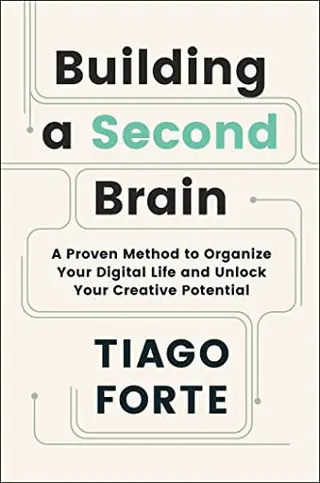
Building a Second Brain
by Tiago Forte · first published 2022
53% recommend47% neutral
Why HN recommends it
Practical note-taking system built on PARA organization, CODE workflow, and progressive summarization; readers find it directly usable and lighter than Zettelkasten. Suits people drowning in notes, clips, and ideas.
Summarised by Claude from recommending comments
For the first time in history, we have instantaneous access to the world’s knowledge. There has never been a better time to learn, to contribute, and to improve ourselves. Yet, rather than feeling empowered, we are often left feeling overwhelmed by this constant influx of information. The very knowledge that was supposed to set us free has instead led to the paralyzing stress of believing we’ll never know or remember enough. Now, this eye-opening and accessible guide shows how you can easily create your own personal system for knowledge management, otherwise known as a Second Brain. As a tr
Affiliate links. As an Amazon Associate I earn from qualifying purchases.
Mentions per year
What Hacker News says
Related books
 2018–2026
How to Take Smart Notes
Sönke Ahrens
Recommended by 49 · mentioned by 7749 recommend · 77 mention49 recommend · 7749 recommend
 2018–2026
Paper machines
Markus Krajewski, Peter Krapp
Recommended by 1 · mentioned by 31 recommend · 3 mention1 recommend · 31 recommend
 2007–2026
Getting Things Done
David Allen
Recommended by 116 · mentioned by 199116 recommend · 199 mention116 recommend · 199116 recommend
 2018–2026
Atomic Habits
James Clear
Recommended by 191 · mentioned by 335191 recommend · 335 mention191 recommend · 335191 recommend
 2017–2026
Crafting Interpreters
Robert Nystrom
Recommended by 295 · mentioned by 397295 recommend · 397 mention295 recommend · 397295 recommend
See Tiago Forte's "Building a Second Brain" (esp. the PARA approach, and Progressive Summarization note-taking technique) for a comprehensive system that answers precisely your question. More generally, this topic has come to be referred to as…
on “Ask HN: What is a sustainable methodology for taking notes of your learning?” ↗I've been using the PARA system from Building a Second Brain by Tiago Forte for all of my new notes and interest hoarding. After I've read a link, I'll quickly file it away into an inbox with some useful snippets on the page. When I'm bored, or have additional…
on “My Bad Habit of Hoarding Information” ↗…I had read How to Take Smart Notes. This discussed the slip box method. I was recording ideas in Obsidian. But I was not reviewing them. Fast forward another year, I saw a mention of a book called Building a Second Brain by Tiago Forte. I bought it and read it in 3 sittings. The concept was that you are only capturing what resonates with you. Stuff that is actionable for your projects. The structure of your folders…
on “Ask HN: How Do You Utilize Your Personal Knowledge Base?” ↗…injury from a car accident in high school, and am incredibly dependent on using Obsidian as sort of a "second brain." While I've only adopted about half of the methods outlined in Tiago Forte's book, Building a Second Brain [1], it's been very effective for me. I prefer hierarchical folder structure for organization, but I do use his overall PARA structure. I also use an "inbox" or intake folder inspired by Zettelkasten…
on “Obsidian 1.4.10 Desktop (Public)” ↗…but there is no single book developed that can implant that mental map. And that is true in most fields. It takes seeing multiple perspectives to figure out what will "stick" with you. Tiago Forte's "Building a Second Brain" stuck with me because I had already read "Getting Things Done" and a number of other productivity books. (As but one example.)
on “Fighting Infomania: Why 80% of Your Reading Is a Waste of Time (2016)” ↗I bought the book "Building a Second Brain"[^1] by Tiago Forte and its recommended PARA methods is well-conceived, directly usable and tried and trusted for me. There is even a follow-up book from him about PARA only [^2]. I recommend to check…
on “Tips on how to structure your home directory (2023)” ↗There's a entire book out there about this particular subject called "Building a Second Brain", written by Tiago Forte. https://www.buildingasecondbrain.com/ I've read it and it's pretty good. Maybe you should give it a try as well.
on “Ask HN: How do you store the knowledge gained in a day?” ↗I tried Zettelkasten a few months ago and I found a lot of what you said to be true. It also has a serious upfront labor overhead that really makes it hard to stick with. Then I discovered Building a Second Brain and it's P.A.R.A. method which was like Just-in-Time Zettelkasten and it's suddenly become a cornerstone of my productivity routine. I compare the two approaches in this blog post: I recently studied…
on “Stop Taking Regular Notes; Use a Zettelkasten Instead” ↗What kind of format would it be published in? This is pretty interesting as it is a problem I struggle with too. Your landing page there reminds me of something else I’m a fan of, e.g. Building a Second Brain through notes and web clips as discussed here: https://tanners.blog/diy-second-brain/ But these are more focused solely on the background processes of organizing information. I’m curious about how your…
on “TikTok and the network effects of creativity” ↗…recently, and I give credit to two basic things: Listening to the Huberman Lab podcast (which echoes a lot of good advice in this comment section, and focuses on physiology), and using the system from "Building a Second Brain" to get myself organized. I've always had a problem with having too many ideas and not enough time and energy to pursue them all. Having to choose between them leads fear of missing out on the others,…
on “Ask HN: Struggling with Productivity and Procrastination” ↗I'm a fan of Building a Second Brain too, and I've taken a lot of inspiration from it. In fact, the precise reason I'm working on this project is because "organizing information as a background process" feels a bit too much like navel gazing…
on “TikTok and the network effects of creativity” ↗…things that are no longer immediately relevant without deleting them. I like to think of this as a generic, orthogonal Time dimension. Maybe infogulch's version would be called PAR/T. [0]: I found the Building a Second Brain podcast does a pretty good job of outlining these categories more clearly. Episodes are short ~8m and digestible. https://fortelabs.co/blog/basbpodcast
on “How to build a second brain as a software developer” ↗I found Maggie Appleton’s visual notes on PARA/Building a Second Brain really helpful for understanding and reference: https://maggieappleton.com/basb
on “The PARA Method: A Universal System for Organizing Digital Information” ↗The apps themselves HELP. But you need a system. Something like Building a Second Brain (with CODE and PARA) or Linking Your Thinking. The system helps, but the app enables the system.
on “After Obsidian and Logseq, I give Dendron a try” ↗I came here to basically say this same thing. I also use Obsidian with the "Building a Second Brain" system and I can't imagine trying to function without it at this point. Notes can be functional and useful if done well.
on “Notes apps are where ideas go to die. And that’s good” ↗