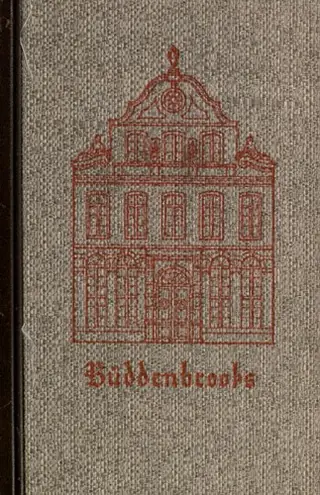
Buddenbrooks
Verfall einer Familie
by Thomas Mann · first published 1909
43% recommend50% neutral7% critical
Why HN recommends it
Long, patient family saga of a merchant household's decline across generations; readers praise its disciplined storytelling, slow build, and view of inherited wealth. Suits fans of immersive, detailed period fiction.
Summarised by Claude from recommending comments
This epic, sub-titled ‘The Decline of a Family’, was Mann’s first novel, published in 1901. It traces the gradual downfall of a wealthy family over four generations in the city of Lubeck. The novel is widely regarded as a classic portrait of bourgeois society and family life in 19th century Germany.
Affiliate links. As an Amazon Associate I earn from qualifying purchases.
Mentions per year
What Hacker News says
Related books
The Magic Mountain
Thomas Mann
Recommended by 20 · mentioned by 3720 recommend · 37 mention20 recommend · 3720 recommend
 2007–2026
Crime and punishment
Recommended by 113 · mentioned by 276113 recommend · 276 mention113 recommend · 276113 recommend
 2008–2026
Ulysses
James Joyce
Recommended by 46 · mentioned by 21946 recommend · 219 mention46 recommend · 21946 recommend
Just finished Buddenbrooks by Thomas Mann. One of the best books I've read, ever. It's long and tedious, and if you like getting lost in minute descriptions of mundane objects and daily routines of people who lived in past eras,…
on “Ask HN: What are you reading?” ↗Buddenbrooks by Thomas Mann. The Last Lion (Alone) by William Manchester.
on “Ask HN: What book(s) did you love reading this year?” ↗Yes! Thomas Mann was in the list of difficult books. I remember marveling how he set up a joke in Buddenbrooks 50 pages before springing the punchline. He's an incredibly disciplined and patient storyteller. Who is your favorite 'difficult' author?
on “Why We Need Difficult Books” ↗We all want the things we consider good for our children. I want my hypothetical ones to read Buddenbrooks, but I know they're probably going to watch YouTube instead. Social media stars are an extension of fame, a basic human desire. It's not surprising (or even particularly civically harmful) that fame…
on “1 in 4 Gen Z-ers plan to become social media influencers” ↗All fiction. - The Great Gatsby. Really enjoyed it and seemed fitting with the current times. - Buddenbrooks, Thomas Mann. Generational wealth come and gone. Good for putting things into perspective. - Things Fall Apart, Achebe. - The Pearl, John Steinbeck - Hyperion (first book), Dan Simmons. Great sci-fi.…
on “Ask HN: What did you read in 2025?” ↗…Companies, nation states of years past can also follow this rough pattern. http://www.historyguide.org/europe/kennan.html > This phenomenon brings to mind a comparison used by Thomas Mann in his great novel Buddenbrooks. Observing that human institutions often show the greatest outward brilliance at a moment when inner decay is in reality farthest advanced, he compared one of those stars whose light shines most brightly…
on “Employee 1: Yahoo” ↗Thomas Mann is a giant of European literature, a Nobel Prize read in universities all across Europe. Chances are it's compulsory reading in German high schools in some way. The Buddenbrooks alone will probably sell a good amount of copies each year. Heinrich Mann was a very important figure during Weimar. Again, chances are it pops up in compulsory reads. I honestly don't know Döblin,…
on “Project Gutenberg blocks access from Germany” ↗…millions of people sharing what they've created in thousand of small, interconnected communities—how could that possibly be more monolithic than everyone reading the same book, no matter how nourishing Buddenbrooks happens to be?
on “In Praise of Boredom” ↗…vergleichbarer Präsenz war – und damit an die Seite der allerersten Hervorbringungen unserer Literaturgeschichte gehört, also an die Seite von Goethes „Werther“, von Fontanes „Effi Briest“, Thomas Manns „Buddenbrooks“, Kafkas „Prozess“, Döblins „Berlin Alexanderplatz“ oder Musils „Mann ohne Eigenschaften“. Which says, that there was no other book [than The Tin Drum] in German language that had a comparable presence…
on “German author Guenter Grass dies” ↗…we had managed to complete, but also the ones we had missed, both tried and failed. In my case, I’ve read War and Peace, Anna Karenina, The Brother Karamazov, Crime and Punishment, The Magic Mountain, Buddenbrooks, Before the Storm (Fontane), The Autumn of the Patriarch, One Hundred Years of Solitude, Vanity Fair, and Middlemarch, among others. I have failed at In Search of Lost Time (only finished first volume),…
on “Ask HN: What works of literature have you completed and which haven’t finished?” ↗I wonder if that's true and how you would measure it. Germany, like the US, was an alliance of different states. If you read Buddenbrooks, there's lots of ethnic humour about the Bavarians and their strange accents. I don't think Germany had the same level of mass immigration - until the 1920s and 30s, when it led to the anti-semitic backlash.…
on “Nobody says hi in San Francisco” ↗…OK not to like things and it's OK to change your mind. I didn't like discworld and I changed my mind. It's also OK not to read things. I've never finished Ulysses or seen the point of Finnigans wake or Buddenbrooks or heaps of other great works. I love Mansfield Park. My partner hates it. Even in Austen you can pick and chose which bit of ivory to pick up.
on “Discworld Rules” ↗…lower-quality reprints of earlier designs. This strongly implies that they weren't a new concept in 1945. The German wikipedia is more interested in the concept and cites the word Adventskalenders to the novel Buddenbrooks, which features one set in the year 1869 but was published in 1901. Either way, the calendars were clearly an established cultural phenomenon well before 1945. Looking at the talk page (for the English…
on “Advent of Code 2025: Number of puzzles reduce from 25 to 12 for the first time” ↗It meant an upper middle class urban citizen, while "Kleinbürger" was their lower middle class counterpart. Buddenbrooks was all about Bürgers, their history and lifestyle. Mann was a member of that class or even of its upper crust, the patricians.
on “How Thomas Mann Wrote the Magic Mountain” ↗