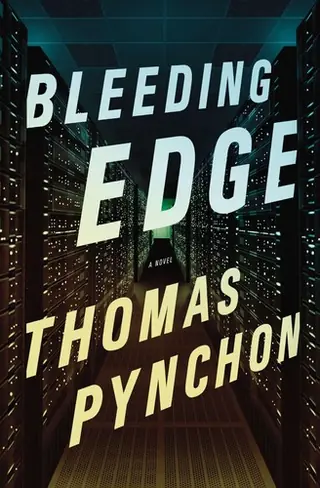
Bleeding Edge
by Thomas Pynchon, Vicente Campos González · first published 2013
57% recommend29% neutral14% critical
Why HN recommends it
Set during the dot-com boom, it's a more approachable entry into Pynchon than Gravity's Rainbow, with a fast-moving plot about paranoia and late-90s tech and finance for readers who want his style without the density.
Common criticism: Some readers find it underwhelming next to his earlier novels.
Summarised by Claude from recommending comments
New York City, 2001. Fraud investigator Maxine Tarnow starts looking into the finances of a computer-security firm and its billionaire geek CEO and discovers there's no shortage of swindlers looking to grab a piece of what's left of the tech bubble.
Affiliate links. As an Amazon Associate I earn from qualifying purchases.
Mentions per year
What Hacker News says
Related books
 2013–2025
Inherent Vice
Thomas Pynchon
Recommended by 15 · mentioned by 2315 recommend · 23 mention15 recommend · 2315 recommend
 2010–2026
The Crying of Lot 49
Thomas Pynchon, Antonio-Prometeo Moya
Recommended by 34 · mentioned by 5734 recommend · 57 mention34 recommend · 5734 recommend
 2008–2026
Gravity's Rainbow
Thomas Pynchon
Recommended by 58 · mentioned by 17958 recommend · 179 mention58 recommend · 17958 recommend
 2012–2025
Against the Day
Thomas Pynchon
Recommended by 14 · mentioned by 1714 recommend · 17 mention14 recommend · 1714 recommend
 2010–2026
Mason & Dixon
Thomas Pynchon
Recommended by 11 · mentioned by 1911 recommend · 19 mention11 recommend · 1911 recommend
 2007–2026
Infinite Jest
David Foster Wallace
Recommended by 145 · mentioned by 421145 recommend · 421 mention145 recommend · 421145 recommend
 2008–2026
Ulysses
James Joyce
Recommended by 46 · mentioned by 21946 recommend · 219 mention46 recommend · 21946 recommend
 2015–2026
Deep Work
Cal Newport
Recommended by 310 · mentioned by 498310 recommend · 498 mention310 recommend · 498310 recommend
"Code Complete 2nd Ed." - McConnell "DevOps Handbook" - Gene Kim et al "Deep Work" - Cal Newport "Tools of Titans" - Tim Ferris "Bleeding Edge" - Thomas Pynchon
on “Ask HN: What books do you keep on your desk?” ↗…East 96th Street, J R parlays a deal for thousands of surplus Navy picnic forks through penny stock flyers and a distant textile-mill bankruptcy into a nationwide, hydra-headed "family of companies." Bleeding Edge - Thomas Pynchon (2013) It deals with government paranoia, conspiracy theories for 9/11, It uses Computer and ‘deepweb’ Internet as the framing device for the novel—which is why I bring it up in this…
on “Books I Recommend” ↗If you want to like Pynchon but are daunted or put off by Gravity's Rainbow, start with Bleeding Edge (2013)
on “Read “Gravity’s Rainbow” fifty years later” ↗I think the entry Pynchon for people on here is Bleeding Edge. Set during the dot com boom with plenty of references to late 90s tech.
on “Pynchon in Public Day” ↗Funny enough there was a moment when reading Bleeding Edge that I noticed that the writing had gotten much better and everything was really Pynchon at his best and within a few pages the characters start talking about Hitler's cologne. The V2 even came up. It…
on “Thomas Pynchon, famously private, sells his archive” ↗Entirely subjectively: Bleeding Edge is a big book, but very easy to read for Pynchon. Crying is tiny, but dense. Vineland isn't huge but I found it hard going (but entertaining and worthwhile). Inherent Vice is a similar size to Vineland…
on “Shadow Ticket” ↗Bleeding Edge is another fun, (relatively) short read if you want to go back for more Pynchon.
on “Dubious Math in Infinite Jest (2009)” ↗It's prose, but have you read Thomas Pynchon's "Bleeding Edge"?
on “On getting poetry” ↗Reminds me of a real-life version of something from Pynchon's Bleeding Edge -- inching toward parody, but still believable. (In this case, unlike in the novel, because it's actually true...)
on ““Let’s, Like, Demolish Laundry”” ↗I just started reading Bleeding Edge, which very much reads like a cyberpunk book in terms of dropping dozens of unelaborated references and allusions, or maybe like Douglas Coupland. Though I’d say it feels more like one of Bruce Sterling’s…
on “The Influence of Neuromancer on Cyberpunk” ↗I’ve been trying to read Bleeding Edge mostly for the tech startup scene and Y2K setting. It reads a lot like a Douglas Coupland novel, especially JPod.
on “Thomas Pynchon, famously private, sells his archive” ↗Glad to hear you are enjoying. I read Bleeding Edge when it came out, but was underwhelmed. It is characteristically Pynchon, but did not enchant me in the same way as did Inherent Vice some years earlier. Still, his best novels have got to be Gravity's…
on “Thomas Pynchon, famously private, sells his archive” ↗Pynchon hired post-docs to research the dotcom bubble and cultural ephemera of the time for BLeeding Edge. Many other writers employ researchers for their writing as well, James Ellroy comes to mind. It's a kind of open secret in the publishing industry. Of course, writers and their publishers alike would…
on “Thomas Pynchon, famously private, sells his archive” ↗I like challenging books but found Gravity's Rainbow annoying and tedious, although I made it to the end. I got halfway through Mason & Dixon before giving up. I figured Bleeding Edge would be better because it's about computers, but it wasn't. So my recommendation is if you don't enjoy Pynchon's books, don't read them :-)
on “Read “Gravity’s Rainbow” fifty years later” ↗…users and conversion therapy advocates. (Contrast that to the New Yorker, which is hardly a commie rag and yet has been unambiguously progressive on that front, among others.) An apt quote from Pynchon's Bleeding Edge, which was published in 2013 but set in 2001: > How right-wing, Maxine wonders, does a person have to be to think of the New York Times as a left-wing newspaper?
on “New York Times tech workers union votes to authorize a strike” ↗