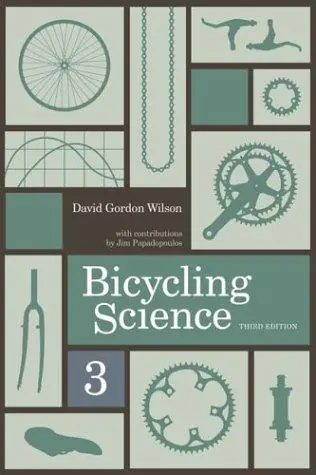
Bicycling science
by David Gordon Wilson · first published 2004
14mentions
9recommended by
13HN commenters
2010–2024first – last mentioned
69% recommend31% neutral
Why HN recommends it
Rigorous engineering treatment of bicycle physics and human power output, with quantitative analysis; suits engineers and serious cycling enthusiasts who want the science behind the machine.
Summarised by Claude from recommending comments
Affiliate links. As an Amazon Associate I earn from qualifying purchases.
In 100 years will we wonder why recumbent bicycles took so long to catch on? MIT's David Gordon Wilson, the writer of the excellent book Bicycling Science, had been advocating for recumbents as a more efficient design to replace traditional modern bicycles for decades. http://news.mit.edu/2017/mit-designer-inventor-author-bike-b... and https://mitpress.mit.edu/books/bicycling-science-third-editi...
on “Why did we wait so long for the bicycle?” ↗for sustained power output of any duration, pedaling a fixed gear crank is about as good as it gets for getting power out of a human body. See Bicycling Science by David Wilson, MIT Press, for some interesting quantitative analysis. As an example to address your specific suggestion of rowing, compare a rowing scull with the Decavitator (MIT built pedal powered…
on “Human-Powered Helicopter Wins the $250,000 Sikorsky Prize” ↗Can anyone recommend serious science and engineering sources on bicycles? I've looked hard and only found a couple: * Bicycling Science by David Gordon Wilson: Book by MIT mechanical engineering professor, going back four editions to the 1970s. https://mitpress.mit.edu/books/bicycling-science-fourth-edit... * "Bicycle Technology" by…
on “Myths in cycling: wider tires are slower” ↗I'm not sure if it's the book to which the author was referring (he doesn't give any references), but I've found Bicycling Science by David Gordon Wilson [MIT Press] to have a very informative treatment of human power generation. It also includes an entertaining introduction concerning the evolution of the modern bicycle. http://www.amazon.com/Bicycling-Science-David-Gordon-Wilson/...
on “Cycling Cadence and Bicycle Gearing” ↗A great book on the science of bicycles is "Bicycling Science" from MIT press. https://www.amazon.com/Bicycling-Science-Press-Gordon-Wilson...
on “Bicycle” ↗If this kind of stuff interests you there is an excellent book on the physics of bicycles http://www.amazon.com/Bicycling-Science-David-Gordon-Wilson/...
on “A bike with a reverse-spinning wheel” ↗…university library and troll through some peer reviewed journals for giggles, or find good books on amazon that are a click and a few days away. One of my favorite books on cycling: http://www.amazon.com/Bicycling-Science-David-Gordon-Wilson/... Not much practical in that, that I remember, but tons and tons of random articles on odd-ball bike stuff. One of the few books I've purchased and randomly read most of a few…
on “It's just wood” ↗…I've never messed with a unicycle. They seem fun. My friend has one; I'll have to try his sometime. Because you mentioned torque and such, if you never have, check out this book: http://www.amazon.com/Bicycling-Science-David-Gordon-Wilson/... I picked it up expecting to read a chapter here and there and ended up cover to covering it. Great read
on “John Conway – The world’s most charismatic mathematician” ↗…recommend Sheldon Brown's delightful knowledgebase, which started in the late 90s: https://www.sheldonbrown.com/ (sadly Mr. Brown is no longer with us, but his web archive lives on) And there's always Bicycling Science for the serious nerds among us https://www.amazon.com/Bicycling-Science-Press-Gordon-Wilson...
on “Bicycle Geometry Terms” ↗I have that book, and it's quite the classic! A lot of it is available on Google books [0]. The more modern take is, of course, Bicycling Science[1]. [0]https://books.google.co.uk/books?id=leq7AQAAQBAJ [1] https://mitpress.mit.edu/books/bicycling-science-third-editi...
on “The Modern Bicycle and Its Accessories (1898) [pdf]” ↗…20W per hand to a bike with both hands. With electromechanical efficiency, 20W per hand comes out to around 1-10W per hand, depending on hand speed and generator efficiency. [1] http://www.amazon.com/Bicycling-Science-David-Gordon-Wilson/... [2] http://dspace.mit.edu/handle/1721.1/69801
on “FlameStower - USB charger powered by fire” ↗Years ago I read about just this thing in a book Bicycling Science(link below). It was super clever. The rear brake was on a spring loaded mount. When it clamped down the caliper would travel a small distance to the rear before hitting a stop. It is pulled by the wheel…
on “Variable tyre pressure wheelset is a mountain biking breakthrough” ↗…acting like tiny pillars. ‘The latter view, odd as it seems, is definitively the case,’ says Jim Papadopoulos from Northeastern University’s College of Engineering in Boston, USA, and the co-author of Bicycling Science. > While it’s easy to believe a bicycle spoke would simply collapse under the weight of bike and rider, he goes on to explain that the tension created in a spoke during the wheel building process (called…
on “Tensegrity Wiki” ↗Bicycles are not a physics 101 problem. In practice this just doesn't happen. See the links I provided. You can also read more about this in the "Bicycling Science" book.
on “Monowheels: Vehicles with Insufficient Wheels” ↗