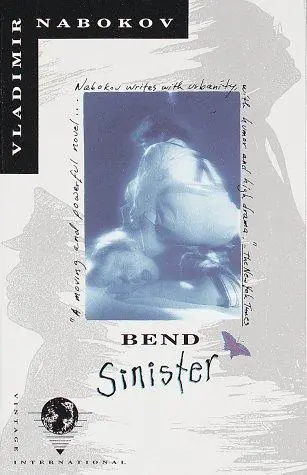
Bend sinister
by Vladimir Nabokov · first published 1947
75% recommend25% neutral
Why HN recommends it
Dense, puzzle-like novel where every detail matters and the question of what is real stays open; readers who like challenging, richly layered fiction and enjoy Nabokov's style tend to find it rewarding.
Summarised by Claude from recommending comments
<p><b>Book
Affiliate links. As an Amazon Associate I earn from qualifying purchases.
Mentions per year
What Hacker News says
Related books
 2010–2024
Transparent things
Vladimir Nabokov
Recommended by 4 · mentioned by 64 recommend · 6 mention4 recommend · 64 recommend
 2010–2024
The Miracle of Mindfulness
Thích Nhất Hạnh
Recommended by 10 · mentioned by 1310 recommend · 13 mention10 recommend · 1310 recommend
 2008–2026
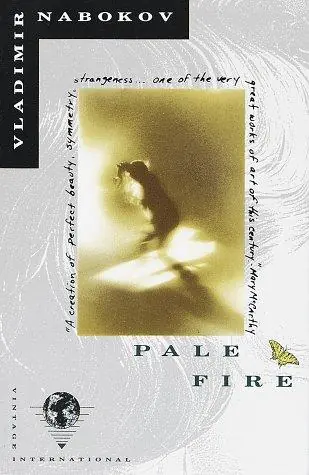
Pale Fire
Vladimir Nabokov
Recommended by 41 · mentioned by 8041 recommend · 80 mention41 recommend · 8041 recommend
 2007–2025
The Moral Animal
Robert Wright
Recommended by 23 · mentioned by 2723 recommend · 27 mention23 recommend · 2723 recommend
 2008–2026
Lolita
Vladimir Nabokov
Recommended by 41 · mentioned by 11741 recommend · 117 mention41 recommend · 11741 recommend
 2008–2026
The Brothers Karamazov
Fiódor Dostoievski, Constance Garrett
Recommended by 86 · mentioned by 18786 recommend · 187 mention86 recommend · 18786 recommend
 2007–2026
Siddhartha
Hermann Hesse
Recommended by 138 · mentioned by 186138 recommend · 186 mention138 recommend · 186138 recommend
 2007–2026
Crime and punishment
Recommended by 113 · mentioned by 276113 recommend · 276 mention113 recommend · 276113 recommend
…plots of Nabokov’s novels. There is no general agreement about the actual plot of Transparent Things, and a lot of argument over what really happened in Lolita. In many of his works, such as Pale Fire and Bend Sinister, you have to think a lot just to apprehend what the plot was, and when you get it, it is as if the author has emerged at the end to consume the story from the beginning, in a glorious spiral of invention.…
on “The Big Sleep: The most baffling film ever made?” ↗Obviously not s-f as such, but - quite a few novels by Nabokov. "The Luzhin Defence" (aka "The Defense"), "The Eye", "Bend Sinister", "Transparent Things" - all very immersing, and posing the question of what's the true reality, its underpinnings and seams. Challenging reads for sure, every detail matters. Some might recommend Pynchon…
on “Ask HN: Books that altered your view of reality” ↗I recently read Despair and Bend Sinister, both by Vladimir Nabokov, and enjoyed both greatly. David Foster Wallace's Infinite Jest also deals with existentialism.
on ““The Idiot” Savant: On Fyodor Dostoevsky’s Idiot” ↗Infinite Jest by David Foster Wallace. Metamorphosis by Kafka. Bend Sinister by Vladimir Nabokov.
on “Ask HN: Which books have made you introspect?” ↗I find this kind of research and political science to be ill-equipped for explaining how people and society work. Fiction like Nabokov's Bend Sinister is able to get much closer to the truth of totalitarianism because it isn't shackled by having to present a thin veneer of data and science, and is more clearly influenced by the author's experiences…
on “Actually, Democracy Dies in H.R.” ↗I highly recommend reading some of his other books if you enjoyed Lolita - I find them to be more complicated (in a good way) and also written magnificently. The Real Life of Sebastian Knight, Bend Sinister, Despair, 'Ada, or Ardor', Pale Fire, and Transparent Things are all personal favorites. But all of his novels are absurdly good. His short story 'Beneficence' may be may favorite piece of writing ever.…
on “Vladimir Nabokov and Edmund Wilson’s Epic Literary Feud” ↗While I actually sympathize with the author's intent, Nabakov is not the best of literary targets, as even his most sympathetic characters form a cabinet of grotesqueries -- vide the protagonists of Pnin, Bend Sinister, or Pale Fire -- and Humbert Humbert is most assuredly a monster. On the other hand, the sexual politics of Nabakov are worthy of interrogation; he is a literary giant, but hardly immune from criticism,…
on “‘His Joy, His Life’: Nabokov and his wife” ↗…unusual, sort of phantasmagoric—a bit like Kafka at his most dreamlike. If you like movies that play games with "what is real", it's in that spirit. The first two English novels Sebastian Knight and Bend Sinister are very much in the style of his Russian novels. But the language of the Russian novels is lush rather than brittle, and this comes out even in the translations. My impression of Nabokov is that he…
on “By the book: reflections on an Indian childhood reading Soviet hardbacks” ↗