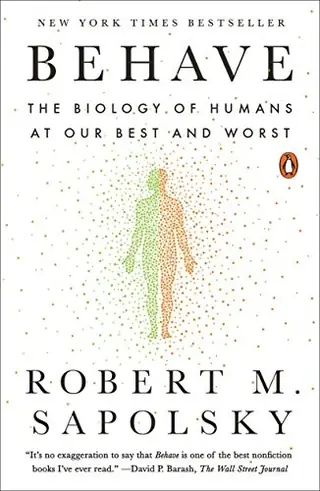
Behave
The Biology of Humans at Our Best and Worst
by Robert M. Sapolsky · first published 2017
65% recommend32% neutral4% critical
Why HN recommends it
Multidisciplinary tour of the brain, hormones, genes and culture behind aggression, cooperation and us-vs-them thinking. Shows nuance between genetic determinism and social construction; suits curious general readers.
Summarised by Claude from recommending comments
Why do we do the things we do? Over a decade in the making, this game-changing book is Robert Sapolsky's genre-shattering attempt to answer that question as fully as perhaps only he could, looking at it from every angle. Sapolsky's storytelling concept is delightful but it also has a powerful intrinsic logic: he starts by looking at the factors that bear on a person's reaction in the precise moment a behavior occurs, and then hops back in time from there, in stages, ultimately ending up at the deep history of our species and its genetic inheritance. And so the first category of explanati
Affiliate links. As an Amazon Associate I earn from qualifying purchases.
Mentions per year
What Hacker News says
Related books
 2022–2023
Shards
Bret Easton Ellis
Recommended by 2 · mentioned by 22 recommend · 2 mention2 recommend · 22 recommend
 2017–2022
The Crisis of the Modern World
René Guénon
Recommended by 3 · mentioned by 33 recommend · 3 mention3 recommend · 33 recommend
 2014–2023
A primate's memoir
Robert M. Sapolsky
Recommended by 9 · mentioned by 119 recommend · 11 mention9 recommend · 119 recommend
 2020–2023
The Warden
Anthony Trollope
Recommended by 2 · mentioned by 22 recommend · 2 mention2 recommend · 22 recommend
 2015–2026
Moral tribes
Joshua David Greene
Recommended by 8 · mentioned by 108 recommend · 10 mention8 recommend · 108 recommend
Mind magic
Bill Harvey
Recommended by 1 · mentioned by 21 recommend · 2 mention1 recommend · 21 recommend
 2021–2024
Opening the heart of compassion
Martin Lowenthal
Recommended by 2 · mentioned by 22 recommend · 2 mention2 recommend · 22 recommend
After reading Behave, I hold Sapolsky in high regard. Even if he provides weak evidence for the claim, the grandmaster in the article loses 15 pounds- or a whopping 11% of his body weight- on average during a 10 day tournament…
on “Why thinking hard makes us feel tired” ↗Speaking of aggression, people often suspect the famous hormone testosterone as one of the prime causes. But Robert Sapolsky's (one of his papers is cited in OP's analysis) book, Behave shows something different: "While testosterone is inextricably tied to aggression, it is far less relevant to aggression than usually assumed." Instead of asking "What do individual levels of testosterone…
on “Mammalian Aggression” ↗…Error by Antonio Damasio • Neuroscience: Exploring the brain by Bear, Connors, and Paradiso (this is a fantastic illustrated text book with great explanations; fully worth the 72 euros I paid for it) • Behave and Why Zebras Don't Get Ulcers by Sapolsky (I wrote my "why" for Behave here[1]) • Moral Tribes by Joshua Greene • The Evolution of Cooperation by Robert Axelrod • Chimpanzee Politics by Frans de…
on “Revisiting “The 4-Hour Workweek”” ↗Take no. 6 for example: Behave by Robert M. Sapolsky. Dr. Sapolsky is a professor at Stanford with nearly 300 publications [0] and has been teaching biology and neurology for years. I'm curious, why do you think this book is pop-pseudoscience?…
If you guys are interested in going down that rabbit hole, I highly recommend Robert Sapolsky's Behave: The Biology of Humans at Our Best and Worst. Although I confess I have only read the first chapter or so, the book sets out to convince its readers that many of the things that can go wrong in the human…
on “Aaron, 5 years later” ↗There's some evidence of a genomic component to future discounting. There's a section on it in Robert Sapolsky's excellent book, Behave: The Biology of Humans at Our Best and Worst.
on “Self-Control in Chimpanzees Relates to General Intelligence” ↗The book Behave by Robert Sapolsky describes this topic (among others) nicely. https://www.penguinrandomhouse.com/books/311787/behave-by-ro...
on “To Remember, the Brain Must Actively Forget” ↗“Behave: the biology of humans at our best and worst” by Sapolsky was my favorite. I knew little about neurobiology, and this went a little deeper.
on “Best book/paper you read in 2018?” ↗Behave: The Biology of Humans at Our Best and Worst, by Robert Sapolsky [1]. A fascinating multidisciplinary approach to explain what happens behind our most consequential behaviours. [1] https://www.goodreads.com/book/show/31170723-behave
on “Ask HN: What, in your opinion, are the greatest and most useful textbooks?” ↗Speaking of biology ... I'm about 60% through the 720-page tome, 'Behave: The Biology of Humans at Our Best and Worst' by Robert Sapolsky. "Electrifying" indeed, as a blurb at the back of the book puts it. The narrative structure is quite compelling, where Sapolsky starts…
on “I should have loved biology” ↗On understanding dopamine, FWIW, I recommend two excellent resources: one is Robert Sapolsky's 720-page tome, Behave—he gives a robust intro to dopamine in the second chapter, "One Second Before", and expands on it further in the book. The other is prof. Andrew Huberman's podcast. He recently did a 2-hour episode[1]…
on “Dopamine, Smartphones and You: A battle for your time” ↗…cooperation/desertion scenarios. And sure enough, some of Greene's papers are cited in the paper you mentioned. His book[1] is worth reading. I picked it up after hearing about it in Robert Sapolsky's, Behave. And for balance, here's an interesting paper[3] critiquing some of Greene's ideas from Moral Tribes. [1] https://www.joshua-greene.net/moral-tribes [2] https://en.wikipedia.org/wiki/Trolley_problem…
on “Why 'Long Rituals' Matter” ↗I'll mention two of mine. NB: they demand sustained reading and require nontrivial time investment. The patient reader will be handsomely rewarded. - Behave, by Robert Sapolsky. Here's[1] my mini review from the past. I've also picked up various other fascinating books from Behave. - Seneca's all of 124 letters. A good English translation is key here. Get…
on “Ask HN: Which books you have read till now that were worth investing time in?” ↗Lying - Sam Harris. Behave - Robert Sapolsky. Gene: An Intimate History - Siddhartha Mukherjee
on “Ask HN: What books have most influenced the way you see the world?” ↗If this sort of topic interests you, I'd highly recommend "Behave" by Robert Sapolsky. A lot of the book examines what is going on in the brains of people who have strongly held "us" vs "them" beliefs (i.e. sexists, racists, homophobes). The core thing with these people…
on “What is empathy?” ↗