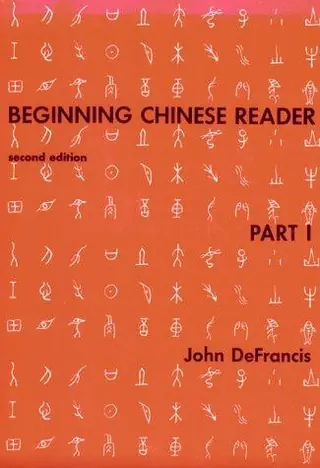
Beginning Chinese Reader
by John DeFrancis · first published 1966
100% recommend
A complete revision. this new version, in _Pīnyīn_ romanization, is aimed at secondary school and college levels. It is an introduction to spoken Pekingese or standard Mandarin, the most widely used Chinese dialect. Based on a vocabulary of some 600 items, the lessons include dialogues, pronunciation drills, sentence-building games, and substitution exercises. Two lessons are devoted to instruction in Chinese characters. There is a combined glossary-index, supplementary vocabulary, and a detailed suggested study guide. John DeFrancis is research professor of Chinese at Seton Hall Univers
Affiliate links. As an Amazon Associate I earn from qualifying purchases.
Mentions per year
What Hacker News says
Related books
 2013–2015
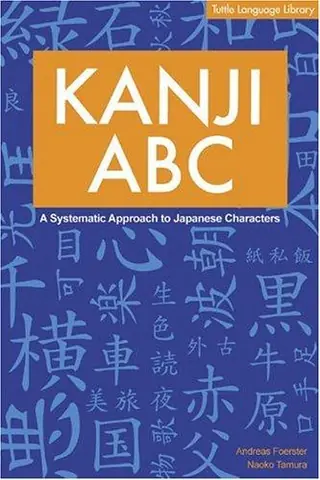
Kanji ABC
Andreas Foerster, Naoko Tamura
Recommended by 2 · mentioned by 22 recommend · 2 mention2 recommend · 22 recommend
 2009–2023
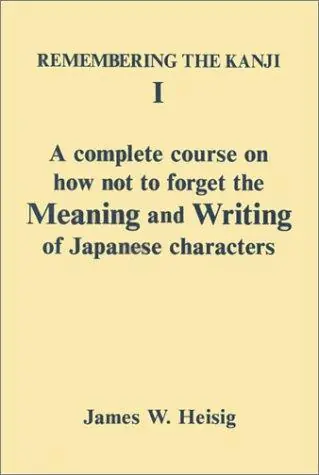
Remembering the Kanji I
James W. Heisig, Tanya Sienko
Recommended by 4 · mentioned by 84 recommend · 8 mention4 recommend · 84 recommend
Remembering the Kanji
James W. Heisig, Tom Minehart
Recommended by 17 · mentioned by 4417 recommend · 44 mention17 recommend · 4417 recommend
…speakers of the language. I'll quote a master language teacher here, the late John DeFrancis. A few years ago, I reread the section "Suggestions for Study" in the front matter of John DeFrancis's book Beginning Chinese Reader, Part I, which I first used to learn Chinese back in 1975. In that section of that book, I found this passage, "Fluency in reading can only be achieved by extensive practice on all the interrelated aspects…
on “Founders' Accents” ↗…University Press and their accompanying audio recordings reflect an older period of standard northern Mandarin, but are much better resources for learning Chinese than Memrise. Especially, DeFrancis's Beginning Chinese Reader is still the royal road for learning to read Chinese, the subject of the article kindly submitted here. DeFrancis made a very careful analysis of reading difficulties second-language learners of Chinese…
on “Learn to read a sentence of Chinese in 3 minutes” ↗…wants to learn a language thoroughly is to do a lot of what the blog post author is doing: reading in the target language. The section "Suggestions for Study" in the front matter of John DeFrancis's book Beginning Chinese Reader, Part I, which I first used to learn Chinese back in 1975 has great advice: "Fluency in reading can only be achieved by extensive practice on all the interrelated aspects of the reading process. To accomplish…
on “Hacking language learning” ↗…appear in "compounds" (meaningful Chinese words). The full argument for doing this is developed by the late John DeFrancis (a brilliant language teacher and textbook author) in the front matter of his book Beginning Chinese Reader,[1] which is still a very worthwhile book decades after it was first published. DeFrancis built in a lot of spaced repetition in the book lessons, back in the days before "spaced repetition" was a trendy…
on “A Year of Spaced Repetition Software in the Classroom” ↗…correspond one-to-one in the manner expected by flashcards. I much preferred learning to read Chinese, for example, by using the excellent Chinese Reader series by John DeFrancis http://www.amazon.com/Beginning-Chinese-Reader-Part/dp/03000... through which I first learned about Bloomfield's approach to foreign language teaching. (DeFrancis was a student of Bloomfield's.)
on “My son's flashcard routine” ↗…Chinese is to use the textbook series written by John DeFrancis (who died just this year). http://books.google.com/books?as_auth=John+DeFrancis&sou... His Chinese Reader series http://www.amazon.com/Beginning-Chinese-Reader-Part-I/dp/030... has never been surpassed. See my HN profile for my basis of knowledge.
on “Ask HN: Hacking Learning Chinese” ↗…to pick up the basic grammar from context. If Chinese strongly favors stative verbs to copulas, I want to figure that out by reading Chinese, not by reading grammar books. This isn't to say that the "Beginning Chinese Reader" isn't excellent. I'm sure it works wonderfully for a great many people. But there's a half-dozen good ways to learn any language, and Memrise or LingQ or full-time conversational immersion might work…
on “Learn to read a sentence of Chinese in 3 minutes” ↗…speakers of the language. I'll quote a master language teacher here, the late John DeFrancis. A few years ago, I reread the section "Suggestions for Study" in the front matter of John DeFrancis's book Beginning Chinese Reader, Part I, which I first used to learn Chinese back in 1975. In that section of that book, I found this passage, "Fluency in reading can only be achieved by extensive practice on all the interrelated aspects…
on “How do you get to write so well in HN?” ↗…speakers of the language. I'll quote a master language teacher here, the late John DeFrancis. A couple years ago, I reread the section "Suggestions for Study" in the front matter of John DeFrancis's book Beginning Chinese Reader, Part I, which I first used to learn Chinese back in 1975. In that section of that book, I found this passage, "Fluency in reading can only be achieved by extensive practice on all the interrelated aspects…
on “Language Learning is Broken” ↗…speakers of the language. I'll quote a master language teacher here, the late John DeFrancis. A few years ago, I reread the section "Suggestions for Study" in the front matter of John DeFrancis's book Beginning Chinese Reader, Part I, which I first used to learn Chinese back in 1975. In that section of that book, I found this passage, "Fluency in reading can only be achieved by extensive practice on all the interrelated aspects…
on “Spaced Repetition is Awesome” ↗…all capital letters like that when I give advice on this subject, as I have frequent occasion to do. Recently, I reread the section "Suggestions for Study" in the front matter of John DeFrancis's book Beginning Chinese Reader, Part I, which I first used to learn Chinese back in 1975. In that section of that book, I found this passage, "Fluency in reading can only be achieved by extensive practice on all the interrelated aspects…
on “Former Stanford dean explains why helicopter parenting is ruining a generation” ↗…speakers of the language. I'll quote a master language teacher here, the late John DeFrancis. A few years ago, I reread the section "Suggestions for Study" in the front matter of John DeFrancis's book Beginning Chinese Reader, Part I, which I first used to learn Chinese back in 1975. In that section of that book, I found this passage, "Fluency in reading can only be achieved by extensive practice on all the interrelated aspects…
on “Studying a foreign language is a physical process as much as it is intellectual” ↗…all capital letters like that when I give advice on this subject, as I have frequent occasion to do. Recently, I reread the section "Suggestions for Study" in the front matter of John DeFrancis's book Beginning Chinese Reader, Part I, which I first used to learn Chinese back in 1975. In that section of that book, I found this passage, "Fluency in reading can only be achieved by extensive practice on all the interrelated aspects…
on “Khan Academy SAT Prep” ↗…speakers of the language. I'll quote a master language teacher here, the late John DeFrancis. A few years ago, I reread the section "Suggestions for Study" in the front matter of John DeFrancis's book Beginning Chinese Reader, Part I, which I first used to learn Chinese back in 1975. In that section of that book, I found this passage, "Fluency in reading can only be achieved by extensive practice on all the interrelated aspects…
on “Ways to learn a language as an adult?” ↗…by native speakers of the language. The late John DeFrancis was a master teacher of Chinese, so I'll quote him on this point here. In the section "Suggestions for Study" in the front matter of his book Beginning Chinese Reader, Part I, DeFrancis writes, "Fluency in reading can only be achieved by extensive practice on all the interrelated aspects of the reading process. To accomplish this we must READ, READ, READ" (capitalization…
on “English has been my pain for 15 years (2013)” ↗