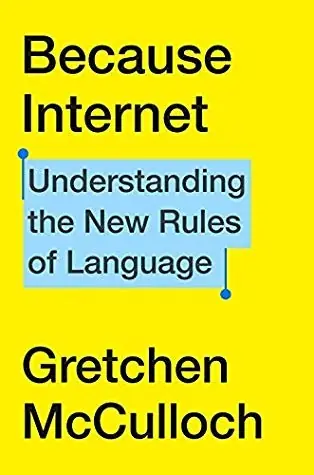
Because Internet
Understanding the New Rules of Language
by Gretchen McCulloch · first published 2019
71% recommend29% neutral
Why HN recommends it
Linguist's accessible look at how internet writing evolved, covering how punctuation, capitalization and emoji-like cues carry tone; suits general readers curious about online language rather than specialists.
Summarised by Claude from recommending comments
Because Internet is for anyone who's ever puzzled over how to punctuate a text message or wondered where memes come from. It's the perfect book for understanding how the internet is changing the English language, why that's a good thing, and what our online interactions reveal about who we are. Language is humanity's most spectacular open-source project, and the internet is making our language change faster and in more interesting ways than ever before. Internet conversations are structured by the shape of our apps and platforms, from the grammar of status updates to the protocols of commen
Affiliate links. As an Amazon Associate I earn from qualifying purchases.
Your mention of messages ending in a period and this topic in general really makes me recommend Because Internet by Gretchen McCulloch. It's a book by a linguist about the evolution of language on the internet. It does a great job at not only showing how this evolution happened, especially around communicating…
on “A case for using punctuation in Slack” ↗There is a good book about the evolution of written communication as the Internet evolved. "Because Internet" by Gretchen McCulloch goes into some of the subtle implications of using punctuation such as periods ending sentences, capitalization, etc. Text makes it difficult to convey emotions and subtlety so…
on “A case for using punctuation in Slack” ↗I really strongly recommend 'Because Internet: Understanding the New Rules of Language' by Grechen McCulloch. It's a lighthearted linguistic look at how our written communication has changed over the last couple decades since the advent of mainstream…
on “Emojis paved the way for UTF-8 everywhere” ↗> I wouldn’t be surprised if linguists find a new “internet dialect” of English in the future as well. You might be interested in "Because Internet: Understanding the New Rules of Language" by Gretchen McCulloch. McCulloch is a linguist, but it's a light/layperson's book. I really enjoyed it. https://gretchenmcculloch.com/book/
on “Why isn’t there an English Academy? Blame the plague” ↗See also Because Internet, by Gretchen McCulloch, which explores the phenomenon if internet-speak more thoroughly. https://gretchenmcculloch.com/book/
on “A Defense of Text-Speak” ↗…That can suggest a level of anger or irritation. This is hardly news, of course. And the article is full of links to old sources. There's a nice discussion of this in Gretchen McCullough's 2019 book Because Internet. https://gretchenmcculloch.com/book/ It's interesting to note the way conventions like this arise. And it will continue to evolve. But it's not really any different from any other bit of linguistic…
on “Full Stops Can Annoy Gen Z, Warn Linguists” ↗…introspection/self-analytical side of the argument than the tool-using/self-awareness side. Though both are clearly "intelligent" in the dictionary definition. In casual conversation however, per Gretchen McCulloch's book "Because Internet"[1], I tend to stick with phrases that are most accessible rather than those that are most precise. My experience is that being overly precise in my speech can be off-putting to people. Enough so, that…
on “First Ever Image of a Multi-Planet System Around a Sun-Like Star Captured by ESO” ↗Likely yes. Gretchen McCulloch has a book called Because Internet which talks about how the internet has changed English. People joined the internet in different waves. Each group of had the challenge of re-inventing writing conventions for the writing that falls outside…
on “Workspacer: A tiling window manager for Windows 10” ↗