Basic Category Theory
by Tom Leinster · first published 2014
70% recommend30% neutral
Why HN recommends it
Short, free introduction aimed at readers with some math background, valued for its intuition and mathematical rigor; often suggested as a first text after Awodey or as a step toward working mathematics.
Summarised by Claude from recommending comments
"At the heart of this short introduction to category theory is the idea of a universal property, important throughout mathematics. After an introductory chapter giving the basic definitions, separate chapters explain three ways of expressing universal properties: via adjoint functors, representable functors, and limits. A final chapter ties all three together."--Provided by publisher
Affiliate links. As an Amazon Associate I earn from qualifying purchases.
Mentions per year
What Hacker News says
Related books
Category Theory in Context
Emily Riehl
Recommended by 8 · mentioned by 168 recommend · 16 mention8 recommend · 168 recommend
 2015–2024
How to Bake Pi
Eugenia Cheng
Recommended by 9 · mentioned by 149 recommend · 14 mention9 recommend · 149 recommend
 2009–2026
Conceptual Mathematics
F. William Lawvere, Stephen Hoel Schanuel
Recommended by 36 · mentioned by 4436 recommend · 44 mention36 recommend · 4436 recommend
 2010–2026
Categories for the Working Mathematician
Saunders Mac Lane
Recommended by 4 · mentioned by 284 recommend · 28 mention4 recommend · 284 recommend
 2015–2026
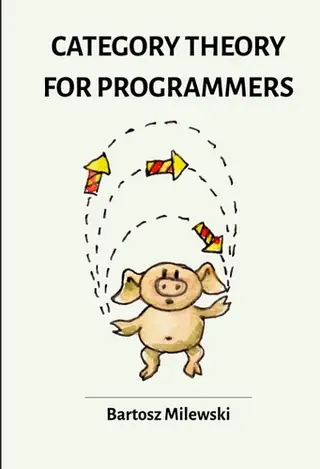
Category Theory for Programmers
Bortosz Milewski, Bartosz Milewski
Recommended by 51 · mentioned by 7851 recommend · 78 mention51 recommend · 7851 recommend
…theory from the perspective of Haskell and C++ programming: https://bartoszmilewski.com/2014/10/28/category-theory-for-p... But the best introduction to category theory I have read is Leinster's book, 'Basic Category Theory': https://arxiv.org/abs/1612.09375 And as you might have guessed, I do agree with your statement!
on “Linguistics Using Category Theory (2018)” ↗…degree in math, my favorite book is Emily Riehl's Category Theory in Context [1] (the "context" in the title refers to a background in math). If you don't know that much math, I'd recommend Tom Leinster's Basic Category Theory [2] or Steve Awodey's Category Theory [3] (particularly if you have some background in computer science or programming). [1] https://math.jhu.edu/~eriehl/context.pdf [2] https://www.maths.ed.ac.uk/~tl/bct/
on “Emily Riehl is rewriting the foundations of higher category theory” ↗…the complete beginner go with epp and then use rosen as a supplement. if you are an advanced undergraduate in math but don’t know category theory then: https://math.jhu.edu/~eriehl/context.pdf or Basic Category Theory by Tom Leinster (even though i’ll list a bunch more resources below i’d probably start with leinster and work up enough math maturity to push through it.) i also liked this: https://arxiv.org/pdf/1912.10642.pdf…
on “How to learn hard things in tech” ↗Agreed on the institute and Spivak. But CWM is, er, for working mathematicians. Leinster's Basic Category Theory, or Awodey Category theory are more unassuming.
on “Applied category theory in chemistry, computing, and social networks [pdf]” ↗If you want to learn category theory in a way that is more orthodox, a lot of people recommend Tom Leinster’s Basic Category Theory, which is free[1]. I’m going to be working through it soon, but the bit I’ve skimmed through looks really good if more “mathsy” than things like TFA. It also does a better job (imo) of justifying the…
on “Category Theory Illustrated – Orders” ↗…lectures' worth of the MMath-level 24-lecture Part III Introduction to Category Theory at Cambridge, I believe. (Source: I took that course last year, and was part of a small reading group studying Leinster's Basic Category Theory at that time. We found that book really, really helpful.)
on “Basic Category Theory” ↗…vector spaces. > (Is there somewhere to read about this to gain intuition?) I don't think you want that. But there definitely are some category theory textbooks, and introductory pdfs. E.g. Tom Leinster Basic Category Theory is a textbook, and it aims to give you intuition. https://arxiv.org/abs/1612.09375
on “Algebra, Topology, Differential Calculus, and Optimization Theory [pdf]” ↗I'm teaching myself category theory, I'll kick back off a local trail, keep notes on the birds I see and read and do the problems in my notebooks. I've got Basic Category Theory by Leinster, and How to Read and Do Proofs by Solow as my references, notebook, pen and a pair of Nikon binoculars.
on “Ask HN: What are you working on? (April 2025)” ↗…read every software engineering book I could get my hands on when I was in school - GoF, Refactoring, SICP, Pragmatic Programmer, XP Explained, Implementation of Functional Programming Languages, TAPL, Basic Category Theory, On Lisp, Art of the Metaobject Protocol, numerous textbooks I wasn't assigned. As a result, my code ended up overcomplicated, with a bunch of cool algorithms, a lot of OO design, a nice smattering of…
on “Ask HN: Tips to become a great programmer” ↗…relatively little mathematical background" to mean that his readers aren't assumed to have previous exposure to category theory, not that they have zero math. He's reiterating the Basic in the title "Basic Category Theory." Category theory is like the refactoring of a lot of math to express commonalities with a view toward recognition and reuse. The Gang-of-Four OOP patterns book would also seem abstract for anyone sans…
on “Basic Category Theory” ↗