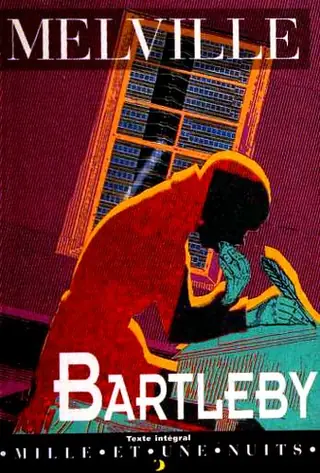
Bartleby, the Scrivener
by Herman Melville · first published 1966
64% recommend32% neutral5% critical
Why HN recommends it
Short, darkly funny story of an office clerk who answers requests with 'I would prefer not to'; valued for its coherence next to Moby Dick and its sharp take on work, apathy and menial office life.
Summarised by Claude from recommending comments
"Bartleby the Scrivener: A Story of Wall Street" is a short story by Herman Melville. The story first appeared, anonymously, in Putnam's Magazine in two parts. The first part appeared in November 1853, with the conclusion published in December 1853. It was reprinted in Melville's The Piazza Tales in 1856 with minor textual alterations. The work is said to have been inspired, in part, by Melville's reading of Emerson, and some have pointed to specific parallels to Emerson's essay, "The Transcendentalist." The story has been adapted twice: once in 1970, starring Paul Scofield, and again in 2001,
Affiliate links. As an Amazon Associate I earn from qualifying purchases.
Mentions per year
What Hacker News says
Related books
 2010–2026
The Call of the Wild
Jack London
Recommended by 14 · mentioned by 3814 recommend · 38 mention14 recommend · 3814 recommend
Murderbot Diaries
Martha Wells
Recommended by 42 · mentioned by 5042 recommend · 50 mention42 recommend · 5042 recommend
 2008–2026
Of Mice and Men
John Steinbeck
Recommended by 12 · mentioned by 4612 recommend · 46 mention12 recommend · 4612 recommend
 2007–2026
Moby Dick
Herman Melville
Recommended by 116 · mentioned by 436116 recommend · 436 mention116 recommend · 436116 recommend
 2008–2026
The Brothers Karamazov
Fiódor Dostoievski, Constance Garrett
Recommended by 86 · mentioned by 18786 recommend · 187 mention86 recommend · 18786 recommend
 2008–2026
Anna Karenina
Louise Maude
Recommended by 67 · mentioned by 18667 recommend · 186 mention67 recommend · 18667 recommend
 2007–2026
The Great Gatsby
F. Scott Fitzgerald
Recommended by 58 · mentioned by 23858 recommend · 238 mention58 recommend · 23858 recommend
 2009–2026
The Count of Monte Cristo
Alexandre Dumas
Recommended by 128 · mentioned by 260128 recommend · 260 mention128 recommend · 260128 recommend
Great advice from Herman Melville’s “Bartleby, the Scrivener”: simply saying “I would prefer not to…” has worked so many times for me.
on “No is a complete sentence” ↗…poems (if nothing else, look at "Born yesterday") T.S. Eliot: "The Love Song of J. Alfred Prufrock", "Return of the Magi", "Hollow men" Ernest Hemmingway: A Clean Well-Lighted Place Herman Melville: Bartleby, the Scrivener Joseph Conrad: Heart of Darkness and The Secret Agent Gustave Flaubert: Madame Bovary George Orwell: Any and all of the essays, but especially "Shooting an elephant" and "A hanging" Stendahl: Red…
on “Becoming "well read"” ↗you should read bartleby the scrivener by melville.
on “On tea and the art of doing nothing” ↗It's a modern version of Herman Melville's "Bartleby the Scrivener". You should read the original, it's very good.
on “Bartholomew L. Bartholomew” ↗This is a modern reimagining of Herman Melville's story _Bartleby the Scrivener_. It's not as easy to read and Bartleby is less toxic and more just annoying, but it's still a great read and plausible, especially in larger companies.
on “Bartholomew L. Bartholomew” ↗Bartleby the Scrivener by Herman Melville (of Moby Dick fame.) Incredibly well-written and hilarious short story about an apathetic office worker. https://en.m.wikipedia.org/wiki/Bartleby,_the_Scrivener http://moglen.law.columbia.edu/LCS/bartleby.pdf
on “Ask HN: Favorite Fiction Books of 2018?” ↗i suggest you read 'bartleby the scrivener' by herman melville[1]. bartleby is most famous for the scene(s) where he tells his manager 'i'd prefer not to' when asked to do basic parts of his job. the full short story is much richer than its most…
on “Ask HN: What tech job would let me get away with the least real work possible?” ↗…simply record the fact, that I was not unemployed in my profession by the late John Jacob Astor;" He could have instead said, "I always worked for John Jacob Astor." For many more examples of this, read "Bartleby, The Scrivener" by Herman Melville. https://gutenberg.org/cache/epub/11231/pg11231.txt
on “Saintcon: Lock Picking Lawyer Keynote” ↗Give Bartleby, the Scrivener a read sometime and it'll probably ring a few bells. That's Herman Melville so mid 19th century.
on “Burnout” ↗I mean, middle class menial existences long predate industrialization. Just read Bartleby, the Scrivener.
on “Humanity's Endgame” ↗Read Bartleby the Scrivener. Or A Christmas Carol.
on “Bring back private offices” ↗…vast impact on national character. If it’s the idea of suffering, frontier, and the impossible but attempted journey, I find it hard to look beyond Melville. Not just for Moby Dick, but I would argue Bartleby, the Scrivener is an incredibly prophetic work about how regular people would come to experience the deep strangeness of modern American life. If it’s a question of language - of how we write and speak to each other…
on “Who Is America's Homer?” ↗…Those approaching it as a novel had every reason to call it a failure. Melville was pushing himself. In jazz I've heard this called "going out." It's something you earn. His lesser-known works like "Bartleby the Scrivener" and "Benito Cereno" are much more coherent and approachable (they stick to a familiar category), but still have much of that slow, mysterious otherworldly quality and are well worth reading (in my humble…
on “The Original 1851 Reviews of Moby Dick” ↗…as above - Life of Pi. The story is so good, the emotions are so real, and the air of absurdity and comedy throughout are so well done - The Martian, it’s again such a good story and fantasy novel - Bartleby, the Scrivener. Something about Bartleby as well as his boss spoke to me, as a young professional early in his career. I also loved the imagery of a clerical office in a Manhattan high rise in the 19th century
on “Ask HN: Which books did you read multiple times?” ↗Much in the way that I would recommend to anyone struggling with "Moby-Dick" to try starting with Melville's much shorter novella "Bartleby, the Scrivener" to get a taste for the authors' style, wit, and use of language; I would suggest a volume of Greene's short stories. In a few or a few dozen pages it is easier to see how he draws a character, uses dialogue,…
on “Unmasking Graham Greene” ↗