Balance of power
by Chris Crawford · first published 1986
55% recommend45% neutral
Why HN recommends it
An influential early geopolitical strategy game that models relationships between countries rather than raw facts. It remains a formative experience for anyone interested in game design.
Summarised by Claude from recommending comments
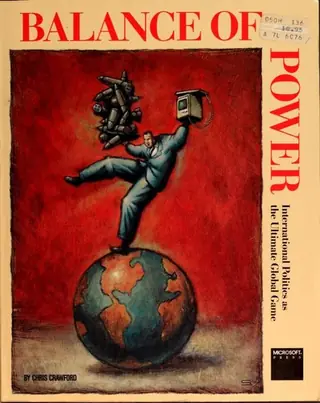
The game Balance of Power (1986) is about the geopolitical situation during the cold war. It aims to teach the player insight into the geopolitical arena by either playing the President of the US or the Secretary General of Russia. The book, written by the lead programmer, describes in a clear style the game rules and processes, and provides a valuable insight into the mind of a game designer. Its focuses on the four main challenges of the game: insurgencies, coup d'etat, Finlandization, and crisis, addressing each of these aspects in detail. Interestingly, the main concepts still apply in 201
Affiliate links. As an Amazon Associate I earn from qualifying purchases.
…context. I think Crawford's artistic program is completely in the wrong, that the Erasmatron is a joke, and that narcissism is largely responsible for leading him down this path. But Eastern Front and Balance of Power are seminal in wargaming and computer gaming, Siboot remains an oft-studied object, and the idea of the storytron was both reasonable and radical in 1993 even though Crawford ended up on a useless path…
on “I Really Blew It (2020)” ↗Off topic, but you just reminded me of the classic game Balance of Power, by Chris Crawford. He has some very interesting thoughts on global political power plays that definitely influenced me as a 20-something. http://www.erasmatazz.com/library/my-books/balance-of-power-...
on “War is expensive. It is impossible to hide the preparation for it” ↗I wonder if there will be a "Finlandization" of software development (concept courtesy of Chris Crawford's classic "Balance of Power" game) where small devs and dev shops align with larger, protective entities that provide defensive protection in exchange for association with the aura of small, indy developers. Think (evilly): Myrhvold's…
on “When Patents Attack” ↗Chris Crawford, the author of the brilliant (for its time) game "Balance of Power," wrote a book about the game and his design process. In it, he pointed out that the simple facts encodedc in the game--such as the GDP of Ghana or the number of troops in Mali--were unimportant, but…
on “Why bother to remember when you can just use Google?” ↗Agreed, and thank you for pointing out the other posts. The remembrance of his friend was particularly affecting. I recall playing Balance of Power, and reading Chris Crawford's book on game design as a teenager in the early 90s. He's had an impact, beyond tilting at windmills and watching his friends grow old.
on “I Really Blew It (2020)” ↗For anyone lacking the context (I just read someone claim "I've never heard of this author or his games"). Crawford, Eastern Front and Balance of Power were a big deal in their day. These were always niche games, but for those in the know, they were brilliant. You can read more about this period of videogame history in the freely available online book…
on “I Really Blew It (2020)” ↗There's quite a bit of stuff from the 80s that is self-aware of videogames as a medium, and is actually studied by academics pretty frequently. Chris Crawford's Balance of Power / Balance of the Planet duo are two that are frequently discussed. Crawford is so sure that his stuff is better than other stuff out there that he's even written several books about why his game design…
on “Portal as a required college text” ↗…question is not very interesting, but the process of answering that question is very interesting. OG Game Developer Chris Crawford, when discussing the design of his economic/geopolitical simulation game “Balance of Power,” said roughly: “The actual GDP of Ghana is not interesting. The mechanisms that drive the GDP of Ghana are very interesting, and that’s what the game tries to explore."
…Narrative History of BSD" by Marshall Kirk McKusick (https://www.youtube.com/watch?v=ds77e3aO9nA). — https://www.youtube.com/user/Froblyx/videos — lectures on game design and development by Chris Crawford (Balance of Power, The Art of Computer Game Design) uploaded by the man himself. "The Dragon Speech" of his can be found elsewhere on YouTube (https://www.youtube.com/watch?v=_04PLBdhqZ4). — https://www.youtube.com/user/VintageCG/videos…
on “Ask HN: Your favorite YouTube channels?” ↗…article makes a point: "Now does it become OK if millions of people in a game instead die in a purely fictional situation of your making? Crawford’s reputation probably hinges a lot on that one screen in “Balance of Power”, for identifying that fictional mass death is fun, so we try to do it a lot in games. Introversion’s “Defcon” chooses a more camp or retro approach to remind the player that millions are dying in a nuclear…
on “Ethics in Strategy Gaming, Part 1: Panzer General” ↗I remember playing Balance of Power long after it had become abandonware, with binaries downloaded from Home of the Underdogs. Chris Crawford wrote a book on it, published by Microsoft Press! https://openlibrary.org/books/OL2724511M/Balance_of_power
on “The Dragon Speech, and Chris Crawford's Improbable Dream” ↗