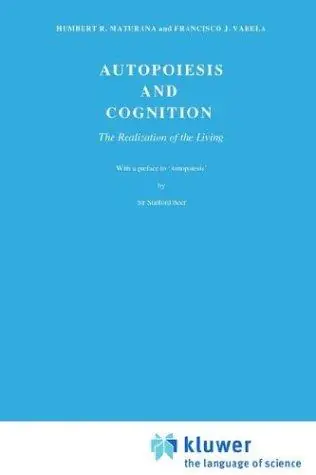
Autopoiesis and cognition
the realization of the living
by Humberto R. Maturana, H.R. Maturana, F.J. Varela · first published 1899
12mentions
4recommended by
5HN commenters
2013–2026first – last mentioned
80% recommend20% neutral
Affiliate links. As an Amazon Associate I earn from qualifying purchases.
Mentions per year
What Hacker News says
Related books
 2016–2026
Understanding computers and cognition
Terry Winograd, Fernando Flores
Recommended by 4 · mentioned by 64 recommend · 6 mention4 recommend · 64 recommend
 2010–2026
The Inner Game of Tennis
W. Timothy Gallwey
Recommended by 74 · mentioned by 10474 recommend · 104 mention74 recommend · 10474 recommend
 2015–2026
The vital question
Nick Lane
Recommended by 66 · mentioned by 8466 recommend · 84 mention66 recommend · 8466 recommend
Would you also consider then: _The Laws of Form_ by George Spencer Brown, Anything about logic by Gotthard Günther :) (He's a rare bird.) _Autopoiesis and Cognition: the Realization of the Living_ by Maturana and Varela Anything by Niklass Luhmann about social systems: the economy, mass media, art, functional differentiation, … He was a student of Talcott Parsons…
on “Alan Kay's reading list” ↗You nailed it. Asking the question is asking to define from the outside what is an inner recursive process. The question is a simple confusion of domains. This is Humbert Maturana’s main point in Autopoiesis and Cognition (1980, now reissued). Recommend the whole book, as does Terry Winograd. The most intense part is the appendix specifically about the nervous system. Nagel and others knew no neuroscience and are clueless…
on “What Is It Like to Be a Bat? [pdf]” ↗My favorite exploration of this topic is found in Maturana and Varela's "Autopoiesis and cognition: the realization of the living". Cells have to "work" to preserve their ability to go on preserving their ability to ... (etc. recursively). Viruses don't. http://en.wikipedia.org/wiki/Autopoiesis
on “Biggest Virus Yet Found, May Be Fourth Domain of Life?” ↗…typology. I think RK would enjoy Humberto Maturana’s take on cognition and self-cognition. Maturana usually does not use the word “consciousness”. Start with Maturana’s book with Francisco Valera: Autopoiesis and Cognition: The Realization of the Living (1970) The appendix of this book is important (“The Nervous System”). Last few pages blew my brain or mind ;-) Thinking about consciousness without thinking more deeply…
on “A landscape of consciousness: Toward a taxonomy of explanations and implications” ↗…and Death” that is focused on the Kreb’s cycle. He brings biochemistry and bioenergetics alive in a way that will impact your thinking. Maturana and Valera gave a brilliant definition of “living” in Autopoiesis and Cognition: The Realization of the Living” (1980). But their writing style will make this a tough read. Terry Winograd write a useful summary if Maturana’s philosophy in his computer science classic “Computers and…
on “Mitochondria Are Alive” ↗This is the book you will want to read once, twice, or three times to have a good answer to your question. Humbert Maturana and Francesco Valera(1979) Autopoiesis and Cognition: The Realization of the Living. ISBN 90-277-1015-5. Not an easy book, but one that answers your question. Terry Winograd loves this book. I am a neuroscientist and only found this gem late in my career.…
on “What is it like to be a thermostat? (1996)” ↗…Bodies may be essential soon along with all of the hard knocks of selection as motivation to memorize, learn, adapt. Here is a great book that Terry Winograd and Fernando Flores read very carefully: “Autopoiesis and Cognition: The Realization of the Living” by Maturana and Valera (1980). This intense book is an axiomatic approach to life and cognition. Enactivist philosophers are now extending their original insights: 1:…
on “Memory makes computation universal, remember?” ↗…missing is autonomous mechanisms of self-controlled balancing between attention to the internal processes and the external needs. Bravo Vitali. You would probably greatly enjoy Maturana and Valera’s Autopoiesis and Cognition (1980).
on “The Consciousness Gradient: When Machines Begin to Wonder” ↗I find Maturana’s definition satisfactory. Best overview in his book with Francesco Valera: Autopoiesis and Cognition: The Realization of the Living (1980) https://en.wikipedia.org/wiki/Autopoiesis_and_Cognition:_The... Unfortunately out of print.
on “Tiny microbe challenges the definition of cellular life” ↗…ten other scientists) who understand some of the core requirements of autonomy (but not all). One hard but invaluable book to read before contending with the word autonomy: Maturana HC, Varela F (1980) Autopoiesis and Cognition. Finally reissued as a paperback.
on “Project Operational Autonomy: our agent-to-agent-future” ↗…credited in this area, also. One of my favorite materials produced by the two, which actually got me started on the path of learning/reading as much as I could, in this space, in the last 25+ years, is: "Autopoiesis and Cognition - The Realization of the Living".
on “Systems Explained by Humberto Maturana” ↗…(auto-) 'self', and ποίησις (poiesis) 'creation, production') refers to a system capable of producing and maintaining itself by creating its own parts.[1] The term was introduced in the 1972 publication Autopoiesis and Cognition: The Realization of the Living by Chilean biologists Humberto Maturana and Francisco Varela to define the self-maintaining chemistry of living cells. """ I had the opportunity to attend a couple of his…
on “Systems Explained by Humberto Maturana” ↗