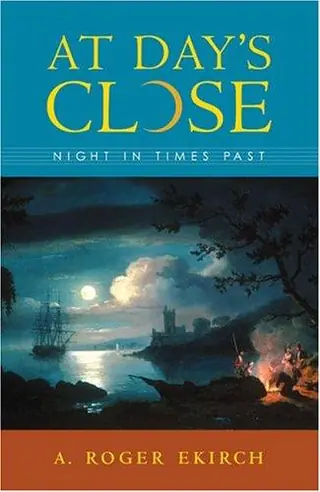
At Day's Close
by A. Roger Ekirch, Roger A. Ekirch · first published 2005
16mentions
3recommended by
12HN commenters
2011–2025first – last mentioned
25% recommend75% neutral
Of particular interest to me, this book details the pre-industrial sleep pattern of segmented sleep, in particular describing "first sleep" followed by a period of "watch" and subsequently "second sleep". A Library of Congress webcast featuring the author discussing his book (http://www.loc.gov/today/cyberlc/feature_wdesc.php?rec=3730) describes "At Day's Close" this way: "examines the history of nocturnal activity in society in Western Europe, from Scandinavia to the Mediterranean, before the advent of the Industrial Revolution. Ekirch describes how nighttime embodied a distinct culture
Affiliate links. As an Amazon Associate I earn from qualifying purchases.
The Ekirch book referred to is At Day's Close: Night in Times Past [1]. It covers much more than sleep patterns. We think of night as merely the absence of daylight, but in the past it was seen as a different world. [1] http://www.amazon.com/At-Days-Close-Night-Times/dp/039332901...
on “We used to sleep twice each night” ↗At Day's Close by Roger Ekirch is a great book about our historical relationship to the night (sleep and not sleeping). http://www.amazon.com/At-Days-Close-Night-Times/dp/039332901...
on “Real Men Go to Sleep” ↗Definitely recommend the book in the post. At Day's Close by A. Roger Ekrich. Beautiful writing. http://www.amazon.com/At-Days-Close-Night-Times/dp/039332901...
on “How did people sleep in the Middle Ages?” ↗Very interesting. There was one other scholarly work in this general area — but that was comparatively much more recent: Roger Ekirch’s “At Day’s Close” [1], which is very well-researched and covers pre-artificial-light Europe. [1] https://www.amazon.com/At-Days-Close-Night-Times/dp/03933290...
on “Archaeologists investigate what life was like after dark in the ancient world” ↗For a more historical take on our relationship with the night, I highly recommend At Day's Close by A. Roger Ekirch
on “Why office workers can't sleep and why that's bad” ↗Highly recommend A. Roger Ekrich’s At Day’s Close: http://books.wwnorton.com/books/At-Days-Close/ Not only is it a great book on the subject, but the writing is exquisite.
on “What I learned by living without artificial light” ↗At Day’s Close is a really great book. This article doesn’t do Ekrich’s work justice. https://wwnorton.com/books/9780393329018
on “The medieval habit of ‘two sleeps’” ↗…and safer, so it got used more. It affected how we sleep: http://aeon.co/magazine/psychology/why-broken-sleep-is-a-gol... > Prior to Edison, says the Virginia Tech historian A Roger Ekirch, author of At Day’s Close: Night in Times Past (2005), sleep had been divided into two distinct segments, separated by a period of night-waking that lasted between one and several hours. The pattern was called segmented sleep.…
on “Back-lit e-readers 'damage sleep and health,' doctors warn” ↗> A Roger Ekirch, author of At Day’s Close: Night in Times Past (2005), sleep had been divided into two distinct segments, separated by a period of night-waking that lasted between one and several hours. The pattern was called segmented sleep…
on “Back-lit e-readers 'damage sleep and health,' doctors warn” ↗The article isn't a scientific enquiry, but it reports on the theme of the book At Day's Close: Night in Times Past (98 citations on Google Scholar)[1]. This book apparently packs a great amount of endnotes and sources. [1]: https://scholar.google.com/scholar?cites=8924290322670217203...
on “Humans used to sleep in two shifts” ↗…debate about whether a schedule like this, often called "biphasic sleep", was more common in pre-industrial societies. There's a historian called Roger Ekirch who thinks it was, starting in his 2004 book "At Day's Close - Night in Times Past". There's a bunch of criticism of it, since the sources are a bit ambiguous, or if he's generalizing from Medieval England (his main focus).
on “28h Days: year 1 update” ↗Oh, I don't know about that. In Ekrich's ' At Day's Close: Night in Times Past' [1] seems in pre-industrial age society the norm was 'bi-modal sleep'. First or "deep" or "dead" sleep, as it was sometimes called, often seems to have taken place shortly after…
on “Let Teenagers Sleep In” ↗…http://www.historycooperative.org/journals/ahr/106.2/ah00034... The author apparently has a book on the same topic which I really ought to read, but the preceding is the article mentioned on his profile-page: > _At Day’s Close: Night in Times Past_ (W.W. Norton, 2005), a sweeping study of nocturnal culture before the Industrial Revolution, which garnered four prizes, including an award given by the history honor society Phi…
on “Alternate Sleep Cycles” ↗It's thought to be a more natural sleep pattern, and us westerners have beaten it out of ourselves: http://www.bbc.co.uk/news/magazine-16964783 "His book At Day's Close: Night in Times Past, published four years later, unearths more than 500 references to a segmented sleeping pattern - in diaries, court records, medical books and literature, from Homer's Odyssey to an…
on “Real Men Go to Sleep” ↗Was there ever other sources for the second sleep, other than "At Day's Close"?
on “Thinking of yourself as an insomniac may be a part of the problem” ↗