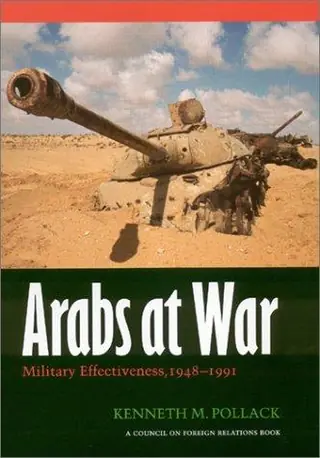
Arabs at War
by Kenneth M. Pollack · first published 2002
4mentions
2recommended by
2HN commenters
2019–2025first – last mentioned
100% recommend
Kenneth M. Pollack, formerly a Persian Gulf military analyst at the CIA and Director for Persian Gulf Affairs at the National Security Council, describes and analyzes the military history of the six key Arab states--Egypt, Iraq, Jordan, Libya, Saudi Arabia, and Syria--during the post-World War II era. This is the first time that the complete postwar histories of virtually all of these countries have been recorded in unclassified form. In particular Pollack focuses on the Arab armies themselves, helping to illuminate the persistent problems they encountered on the battlefield. He shows in detai
Affiliate links. As an Amazon Associate I earn from qualifying purchases.
An excellent and very readable book on this in the modern era is "Arabs at War" by Kenneth M. Pollack He examines a number of recent wars in the area of interest and discusses some of the common findings he makes. He also finds a number of situations in which armies in the region…
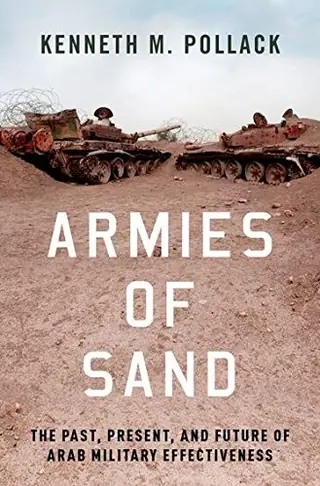
on “Why Arabs Lose Wars (1999)” ↗One researcher the author relies on, Kenneth Pollack, published his dissertation work in two books Arabs at War (2004) and Armies of Sand (2019). The first gives very good overviews of Arab combat performance over the 20th century. The second tries to place it all in a theoretical framework. While the 2019 book…
on “Why Arabs Lose Wars (1999)” ↗TFA is based on the dissertation work of Kenneth M. Pollack. If you are into military history, his Arabs at War (2002) contains the historical part of the dissertation and is very informative. His second book, Armies of Sand (2019), contains the theoretical part and I didn't feel that it added much understanding.
on “Why Arabs Lose Wars (1999)” ↗This article seems derivative of Kenneth M. Pollack's dissertation, published as Arabs at War: Military Effectiveness, 1948-1991 (2004). His second book, Armies of Sand: The Past, Present, and Future of Arab Military Effectiveness (2019) doesn't add much to his basic argument.
on “Why Arabs Lose Wars (2000)” ↗