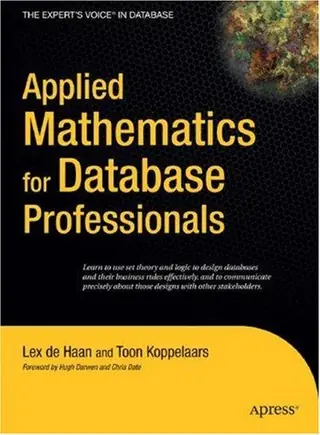
Applied mathematics for database professionals
by Lex de Haan · first published 2007
12mentions
5recommended by
8HN commenters
2012–2024first – last mentioned
63% recommend38% neutral
Why HN recommends it
Provides a thorough grounding in logic, set theory and discrete math as applied to relational databases. It explains database theory from first principles and describes queries formally.
Summarised by Claude from recommending comments
Affiliate links. As an Amazon Associate I earn from qualifying purchases.
Mentions per year
What Hacker News says
Related books
 2017–2024
Applied Mathematics for Database Professionals
Lex deHaan, Toon Koppelaars
Recommended by 2 · mentioned by 32 recommend · 3 mention2 recommend · 32 recommend
 2013–2025
Developing time-oriented database applications in SQL
Richard T. Snodgrass, Christian S. Jensen
Recommended by 6 · mentioned by 96 recommend · 9 mention6 recommend · 96 recommend
 2009–2024
An introduction to database systems
C. J. Date
Recommended by 14 · mentioned by 2314 recommend · 23 mention14 recommend · 2314 recommend
…understanding software. All software deals with data. If you don't have a good understanding of data, you are never going to have a good understanding of software. One of the best books I've ever read was Applied Mathematics for Database Professionals by Lex de Haan, and Toon Koppelaars. I think that's the database equivalent of SICP. You need to read it and understand it if you want to seriously deal with data. And you want to if you want to write…
on “SQL is 43 years old – Here’s why we still use it today” ↗…not good ones. Finally, since this is so long now, I want to point out that I didn't generate these ideas all on my own. I've been heavily influenced by Lex de Haan and Toon Kopplaars in their book, Applied Mathematics for Database Professionals.
on “Web Developer Security Checklist” ↗Lex de Haan and Toon Koppelaars, Applied Mathematics for Database Professionals -- a fairly gentle introduction to database theory starting with logic & discrete math Ralph Kimball and Margy Ross, The Data Warehouse Toolkit -- even if you're in an OLTP context, it's useful to know…
on “Ask HN: What are some good books for SQL/DBA?” ↗de Haan & Koppelaars' _Applied Mathematics for Database Professionals_ is well worth your time, especially if you haven't studied discrete math yet.
on “Ask HN: Which DB internals to study more to become expert in DBs overall??” ↗Very clear. I found that the met comprehensive explanation of normalization was in an APress book, Applied Mathematics for Database Professionals. Incidentally, did you cover 4NF and 5NF in the course? IMO, you'll almost never need 6NF.
on “Understanding database normalisation: a very short tutorial” ↗I have to say that my favourite book ever on Computer Science Mathematics is actually Applied Mathematics for Database Professionals, by APress. It gave me an extremely thorough understanding of logic, set theory, and disabused me of my incorrect notion that relational databases were because of ER diagrams :-)
on “Mathematics for Computer Science” ↗There's a book that every person who is serious about databases should read: it's "Applied Mathematics for Database Professionals", by APress. See here: http://www.apress.com/9781590597453 Here is the table of contents, just to give you an idea of why it's such an amazing book: Table of Contents 1. Logic: Introduction 2. Set…
on “What every computer science major should know (2011)” ↗Another Toon fan here. HE also co-wrote a book called Applied Mathematics for Database Professionals that is superb. It's dry, like a textbook. But the clarity and depth that they have on the underpinnings of how all this works and why it does is excellent.
on “Advanced SQL window function quiz” ↗There is a book, Applied Mathematics for Database professionals that uses a terse mathematical notation to describe queries and I remember actually kind of liking it. I especially like that they used it to describe the state of the database and the transforms.
on “A Short Story About SQL’s Biggest Rival” ↗…their ability) or the stored procedures that achieve the same but are still procedural (and is still bound to fail for essentially the same reason). If you know about TTM, you might also know about "Applied Mathematics for Database Professionals". What I'm referring to is their "execution model 6" becoming possible *WITHOUT* any [procedural form of] coding [by mere programmers]. Another way of saying this is "You can have CREATE ASSERTION if…
on “Open Source SQL Parsers” ↗…Depth, "...the principles are common sense-but they're formalised common sense. (Common sense might be common, but it's not so easy to say exactly what it is!)". Formalisation of your normalisation! Applied Mathematics for Database Professionals is on the reading list, looking forward to it.
on “Understanding database normalisation: a very short tutorial” ↗…from his books, except a deep irritation partly due to his absolute pedantry... I finally learned SQL with a gentle introduction by Alan Beaulieu. I stumbled upon another book that's about the theory: Applied Mathematics for Database Professionals, by Lex deHaan, and Toon Koppelaars. Maybe these authors will benevolently teach me relational theory. But please avoid C. J. Date's books. And don't be him when writing a book or trying to explain something…
on “SQL is syntactic sugar for relational algebra” ↗