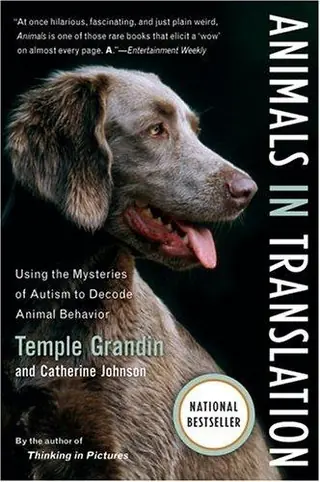
Animals in translation
using the mysteries of autism to decode animal behavior
by Temple Grandin · first published 2004
9mentions
4recommended by
6HN commenters
2008–2023first – last mentioned
67% recommend33% neutral
An animal scientist draws on her experience as an autistic to identify commonalities between animals and autistics, offering insight into how animals process sensory information and how they often possess unrecognized savant-level talents.
Affiliate links. As an Amazon Associate I earn from qualifying purchases.
…by Richard Muller. It gives an overview of physics, emphasizing why the concepts are important in the modern world, rather than the math details. If she's interested in biology, you might consider "Animals in Translation" by Temple Grandin. It's more about animals than about technology, but it touches on how understanding animals affects the low-tech systems that you use to handle them. For interesting/easy intros to…
on “Ask HN: What are some good general technical books for teenagers?” ↗…think in a rational manner unless it was to cause him/her to focus on things more." I think this is probably a symptom of what I described above, rather than the root cause. Read Temple Grandin's book Animals in Translation if you want a better account. The book is written by an autistic woman who discovered that she has a really uncanny ability to understand animals. Basically she is able to see which stimuli are causing…
on “Why I gave marijuana to my autistic child” ↗The disadvantage of intelligence is probably due to single trait selection and not the extra intelligence itself. Temple Grandin's book Animals In Translation has a chapter about this. Ridiculously insightful book too.
on “Lots of Animals Learn, but Smarter Isn’t Better” ↗…can't be usefully generalized." If you read the literature on selective breeding they have extensive methodologies for avoiding genetic problems. If you just want a quick overview, Temple Grandin's book "Animals in Translation" has a couple of really entertaining chapters on the subject.
on “Being too successful is one of life's biggest risks (2004)” ↗…Love of a Dog". Stanley Coren also has some decent books on dog intelligence. These books focus on trying to understand the sorts of experiences you've described. More generally, Temple Grandin's "Animals in Translation" and "Animals Make Us Human" talk about some of these sorts of issues, not just in dogs, but also in cats, horses, pigs, and so on. I think you'll find there's a lot of research going on these topics--…
on “Ask HN: How Would You Design A Doggie IQ Test?” ↗…changed both species. By hunting together, each evolved to emphasize their strengths in the partnership, and lost things they no longer needed. There is a good discussion of this in Temple Grandin's "Animals in Translation". Some scientists even think it was our ancestor's symbiotic relationship with dogs that let them outcompete other groups such as Neanderthals. Dogs are able to figure out human states of mind from…
on “My Favorite Photo Ever: A Military Dog Jumping Out of a Helicopter” ↗This is true, but an important distinction is also the question: does an animal in captivity have the ability to express its fundamental emotional/behavioral drives? Temple Grandin’s book “Animals in Translation“ is the textbook here. Many animals kept in captivity develop what are called “stereotypies”, which is a nicer sounding word for mental illness disorders. Parrots very often have this, because it’s really…
on “Researchers Taught Parrots to Video Call Other Parrots” ↗…her a copy last spring. I don't know if my daughter finished it but I know she said she found it interesting. We have the the math books you mentioned but I haven't heard about the others before. Animals in Translation and Fifty-Nine Story Crisis look really good. Thanks for the reference!
on “Ask HN: What are some good general technical books for teenagers?” ↗Interestingly in the intro to "Animals in Translation" Temple Grandin discusses the fact that is highly possible that in fact human brain size decreased with the domestication of animals (she discusses dogs specifically who she also posits we may have helped…
on “The human brain grew as a result of the extinction of large animals: new paper” ↗