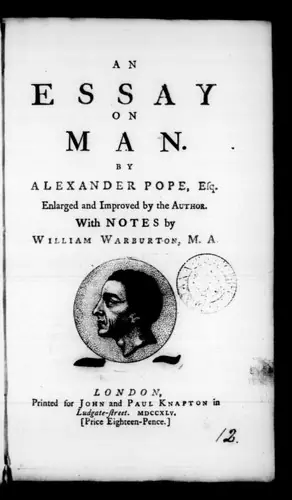
An essay on man
by Alexander Pope · first published 1733
2mentions
0recommended by
2HN commenters
2018–2020first – last mentioned
100% neutral
"Voltaire called it "the most sublime didactic poem ever written in any language." Rousseau rhapsodized about its intellectual consolations. Kant recited long passages of it from memory during his lectures. And Adam Smith and David Hume drew inspiration from it in their writings. This was Alexander Pope's Essay on Man (1733-34), a masterpiece of philosophical poetry, one of the most important and controversial works of the Enlightenment, and one of the most widely read, imitated, and discussed poems of eighteenth-century Europe and America. This volume, which presents the first major new editi
Affiliate links. As an Amazon Associate I earn from qualifying purchases.
…or as Pope puts it “Vice is a monster of so frightful mien As to be hated needs but to be seen; Yet seen too oft, familiar with her face, We first endure, then pity, then embrace.” - Alexander Pope, Essay on Man (1734)
on “Britain’s White-Collar Cops Are Getting Too Good at Their Job” ↗“Hope springs eternal in the human breast, Man never is, but always to be blest." -Alexander Pope, Essay on Man
on “AI pioneer Geoff Hinton: “Deep learning is going to be able to do everything”” ↗