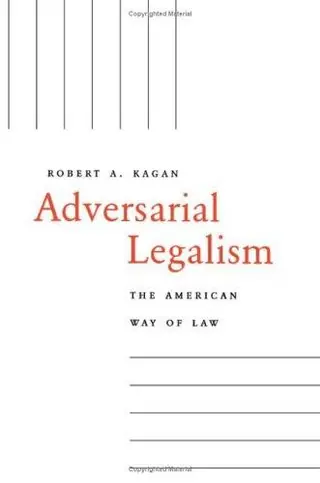
Adversarial Legalism
by Robert A. Kagan · first published 2001
12mentions
1recommended by
2HN commenters
2013–2022first – last mentioned
50% recommend50% neutral
Affiliate links. As an Amazon Associate I earn from qualifying purchases.
…different legal and administrative philosophies from the US, and I don't think the EU is any more corrupt than the US, arguably less so. This subject is discussed very well in a favorite little book, Adversarial Legalism by Robert Kagan.
on “Facebook’s tracking of non-users ruled illegal again in Europe” ↗…common-law country myself I'd be very reluctant to give up that system in favor of a more civil one, warts and all. It is a real problem though. One book that addresses these problems well is Robert Kagan's Adversarial Legalism. As for the situation in the US, there's a school of thought that argues sufficient resolutions have been lodged with Congress to warrant a Constitutional Convention, and last Spring, Indiana, Georgia,…
on “Restore the Fourth” ↗You've probably read it already, but I really enjoyed Robert Kagan's book Adversarial Legalism on this subject. http://www.bsos.umd.edu/gvpt/lpbr/subpages/reviews/kaganal.h...
on “Rescued by a Bailout, A.I.G. May Sue Its Savior” ↗…I grumble about this too frequently already, so I'll stop here, but (re)cite two books I think make particularly succinct critiques: The Collapse of American Criminal Justice by Christopher Stuntz and Adversarial Legalism by Robert Kagan. In a nutshell, both argue that the fact-finding role of trial courts (civil as well as criminal) is seriously impeded by the ever-denser thicket of procedural protections, such that a…
on “Towards Learning From Losing Aaron Swartz: Part 2” ↗…Even then, I don't want to blame the EFF too much, but to critique the peculiarly zero-sum American appraoch to resolving conflicts of interest, as discussed in this excellent book: http://www.amazon.com/Adversarial-Legalism-The-American-Way/...
on “Videogame Publishers: No Preserving Abandoned Games Because “Hacking” Is Illegal” ↗I think that's actually an accurate characterization of the legal system. I highly recommend this book if you're interested: https://www.amazon.com/Adversarial-Legalism-American-Way-Law...
on “Magnet Ban Cleared” ↗I'm afraid I don't really know what to suggest on developing consensus systems. the only thing I can bring to mind right now is a rather dry but worthwhile book called Adversarial Legalism by Robert Kagan which I think has a lot to say about the psychology of disputation in the US and (indirectly) how our whole system of governance has become so politicized.
on “Acute exercise increases expression of telomere protective genes in heart tissue” ↗…approach to this issue would be that you should spend more money suing the person who made the false accusation against you. Although it's a little dense, a really good book on American legal culture is Adversarial Legalism by robert Kagan. Culturally the US is absolutely obsessed with property rights and the exhaustive accounting for them has provided fertile soil for a whole forest of complex litigation practices. Many…
on “Housing a prisoner in California costs more than a year at Harvard” ↗…adversarial legal tradition and while it doesn't touch on German labor unions specifically it does go into some detail about the differences between the (Anglo-)American and continental European approaches. Adversarial Legalism by Robert Kagan. https://www.hup.harvard.edu/catalog.php?isbn=9780674012417
on “Anti-union activity is heating up ahead of Google contractor's vote to unionize” ↗Book suggestion: Adversarial Legalism by Robert Kagan.
on “Grand jury subpoena for Signal user data, Central District of California” ↗…technical debt. If you're interested in this topic (and you should be, because the legal system of a country shapes not only case outcomes but policy formation, cultural mores, and cognitive styles), read Adversarial Legalism by Robert Kagan, whose basic ideas are succinctly summarized here: https://law.stanford.edu/publications/the-same-only-differen...
on “The lucrative economics of expert witnesses” ↗…gist eventually tends towards this core paragraph: > This is a way that America differs from peer countries: Robert Kagan, a law professor at the University of California, Berkeley, has called this “adversarial legalism,” and shown that it’s a distinctively American way of checking state power. Bagley builds on this argument. “Inflexible procedural rules are a hallmark of the American state,” he writes. “The ubiquity…
on “America Needs a Liberalism That Builds, Not Adversarial Legalism” ↗