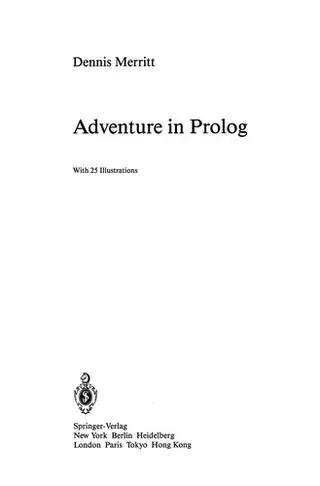
Adventure in Prolog
67% recommend33% neutral
Why HN recommends it
Step-by-step Prolog tutorial that teaches language features by building a text adventure game; enjoyable to work through and a good route into exploring Prolog for beginners.
Summarised by Claude from recommending comments
This book is aimed at the programmer who wishes to learn the advantages of programming in Prolog. It takes a pragmatic rather than theoretical approach to the language, using a full programming example rather than code fragments. The various features of Prolog, such as logic definitions, symbolic reasoning, database manipulation, natural language, I/O, and flow of control, are taught through the step-by-step development of an adventure game - an excellent and fun vehicle for showing Prolog's power. Through the exercises the reader applies the skill learned to the development of three other app
Affiliate links. As an Amazon Associate I earn from qualifying purchases.
Mentions per year
What Hacker News says
Related books
 2008–2026
Clause and Effect
William F. Clocksin
Recommended by 7 · mentioned by 87 recommend · 8 mention7 recommend · 87 recommend
 2009–2026
Programming in Prolog
William F. Clocksin, Christopher S. Mellish
Recommended by 8 · mentioned by 148 recommend · 14 mention8 recommend · 148 recommend
 2009–2026
The craft of Prolog
Richard A. O'Keefe
Recommended by 18 · mentioned by 3018 recommend · 30 mention18 recommend · 3018 recommend
 2009–2026
The art of Prolog
Leon Sterling, Ehud Yehuda Shapiro
Recommended by 36 · mentioned by 6536 recommend · 65 mention36 recommend · 6536 recommend
Adventure in Prolog by Dennis Merritt teaches you different features of Prolog in a step-by-step manner while developing a game.
on “Ask HN: What are some books where the reader learns by building projects?” ↗There's even a book "Adventure in Prolog" by Dennis Merritt (ISBN 1520918917) It's a lot of fun to work through, other prolog resources can be a little dry
on “Prolog Adventure Game” ↗Not even comparable. The OP posted a book, but you posted is a guide of no more than 30 pages. Novice: Adventure in Prolog Learn Prolog Now Logic Programming with Prolog Med - Advanced: Clause and Effect The Art of Prolog The Craft of Prolog Wam Book The Practice of Prolog Prolog Programming for AI - Brakto Deep Dive: Expert…
on “Adventure in Prolog Tutorial (2016)” ↗…will ruin you, you shall be able to slay dragons and at the same time you most likely will not enjoy programming in "modern languages" anymore. (Intro/Novice) Learn Prolog Now (free on the web) Adventure in Prolog(free on the web) Logic Programming with Prolog (Intermediate) The Practice of Prolog Prolog Programming for Artificial Intelligence Prolog Programming In Depth Prolog Experiments in Discrete…
on “The Birth of Prolog (1992) [pdf]” ↗…search strategies. I'd also recommend the standard Prolog textbtook, Prolog Programming for AI, by Ivan Bratko. You can most likely find an edition in most university libraries. I've learned a lot from Adventure in Prolog, a Prolog tutorial on the Amzi! Prolog website (though I used a different Prolog to do the exercises, which is a very good sign of nice, basic and portable examples): http://www.amzi.com/AdventureInProlog/advtop.php…
on “The Birth of Prolog (1992) [pdf]” ↗Here are some resources: https://github.com/klaussinani/awesome-prolog#resources I recall going through the Adventure in Prolog one (free online resource) a while ago and enjoying it, helped direct a lot of exploration into the Prolog language and its capabilities for me. I have Clocksin & Mellish's Programming in Prolog (2003,…
on “Why Learn Prolog in 2021?” ↗…puzzles as it gets with repository items and complicated conditions to advance the game. In fact, Amzi! Prolog uses adventure game coding as a topic for its classic (1980s) introductory Prolog learning book Adventure in Prolog ([1]). Based on a cursory look, most code in that book should run just fine on a modern ISO Prolog engine ([2]) in your browser. [1]: https://www.amzi.com/AdventureInProlog/advtop.php [2]: https://quantumprolog.sgml.net
on “ΛProlog: Logic programming in higher-order logic” ↗I just now started reading Merritt's Adventure in Prolog (1990), and the very beginning seems somehow relevant to this thread: "I was working for an aerospace company in the early 1970s when someone got a copy of the original Adventure game and installed it…
on “AWS gives open source the middle finger?” ↗Just a note on Nani Quest/Adventure in Prolog: it doesn't work in SWI-pl. I gave it a shot about 6 months ago and got to chapter 7 before stuff stopped working right. It was an excellent tutorial up to that point though.
on “Amzi Prolog becomes open source” ↗…Prolog as the computational implementation of the thesis that presents thinking as computation. https://mitpress.mit.edu/books/thinking-computation Other books I have but haven't gone through yet are Adventure in Prolog and The Art of Prolog.
on “Why Learn Prolog in 2021?” ↗