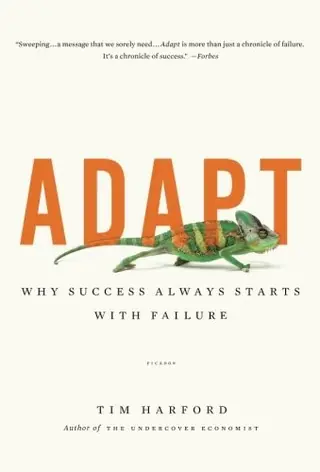
Adapt
by Tim Harford · first published 1960
5mentions
3recommended by
5HN commenters
2012–2023first – last mentioned
60% recommend40% neutral
This book outlines a counterintuitive approach to changing the world by assessing its failures, drawing on myriad disciplines to argue that complex challenges must be met through adaptive trial-and-error practices that do not depend on expert opinions or ready-made solutions. The author shows us a new and inspiring approach to solving the most pressing problems in our lives. When faced with complex situations, we have all become accustomed to looking to our leaders to set out a plan of action and blaze a path to success. He argues that today's challenges simply cannot be tackled with ready-mad
Affiliate links. As an Amazon Associate I earn from qualifying purchases.

…we have a cognitive bias in favor of past success, when past failure might be the more informative signal. Planet Money did an interesting podcast with the author of this book: http://www.amazon.com/Adapt-Success-Always-Starts-Failure/dp... discussing just such a hypothesis: http://www.npr.org/blogs/money/2012/09/04/160555540/episode-...
on “Ask PG: If Viaweb hadn't worked out, what would you have likely done next?” ↗"Adapt: Why Success Always Starts with Failure" by Tim Harford
on “Ask HN: books on critical thinking, analysis and creativity/innovation ?” ↗Tim Harford’s “Adapt: Why Success Always Starts with Failure”¹, an enthralling collection of tales from really diverse projects. I’ll freely admit to only picking it up because I recognised the name from the More or Less²…
on “Ask HN: Favorite nonfiction books of 2018?” ↗…done to some satisfaction; sometimes you get there and it's much more convoluted than anyone had previously assumed. The economist Tim Harford discusses the merits of this funding model quite a bit in Adapt, and is quite supportive of it, as are other economists such as Alex Tabarrok. But it's really not clear that they understand the differences between engineering and science, either. Most of the DARPA/X-prize…
on “A Bad Idea from Congress About How to Fund Science” ↗According to Tim Harford's book "Adapt" it's wrong to expect a company like shell to be good at renewables. Shell are good at handling liquid fuels and negotiating with governments. These are not useful skills for photovoltaics.
on “Shell employees urge CEO to rethink shift from renewables in rare letter” ↗