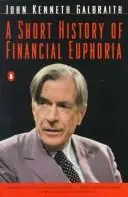
A short history of financial euphoria
by John Kenneth Galbraith · first published 1990
100% recommend
Why HN recommends it
A short, readable account of how financial bubbles form and why markets repeat the same cycles of speculation. It offers a quick, useful primer on the psychology behind booms and crashes.
Summarised by Claude from recommending comments
How is it that, with all the financial know-how and experience of the wizards on Wall Street and elsewhere, the market still goes boom and bust? How come people are so willing to get caught up in the mania of speculation when history tells us that a collapse is almost sure to follow? In A Short History of Financial Euphoria, renowned economist John Kenneth Galbraith reviews, with insight and wit, the common features of the great speculative episodes of the last three centuries - the seventeenth-century craze in Western Europe for investing in an unusual commodity: the tulip; Britain's South S
Affiliate links. As an Amazon Associate I earn from qualifying purchases.
Mentions per year
What Hacker News says
Related books
 2008–2026
Extraordinary Popular Delusions and the Madness of Crowds
Charles MacKay
Recommended by 28 · mentioned by 5428 recommend · 54 mention28 recommend · 5428 recommend
 2010–2026
The big short
Michael Lewis, Francisco José Ramos Mena
Recommended by 99 · mentioned by 20299 recommend · 202 mention99 recommend · 20299 recommend
 2007–2026
The Intelligent Investor
Benjamin Graham
Recommended by 152 · mentioned by 244152 recommend · 244 mention152 recommend · 244152 recommend
 2011–2026
Thinking, fast and slow
Daniel Kahneman
Recommended by 373 · mentioned by 879373 recommend · 879 mention373 recommend · 879373 recommend
Btw, a great, well known quote from John Kenneth Galbraith (from A Short History of Financial Euphoria) is: "The world of finance hails the invention of the wheel over and over again, often in a slightly more unstable version. All financial innovation involves in one form or another, the creation of debt…
on “Demystifying financial leverage” ↗If you think we're in a bubble and you think you might be able to exit it at just the right time, I highly recommend you read "A Short History of Financial Euphoria" by John Kenneth Galbraith.[a] Here's one of my favorite passages from the book: > There are those who are persuaded that some new price-enhancing circumstance is in control, and they expect the market…
on “Today in the U.S. we are in the fourth superbubble of the last hundred years” ↗…get out) and did so too late. This is the irrational exuberance of markets, as documented in every cycle in history. Don't read Mises.org, or at least not only. Read John Kenneth Galbraith's work: "A Short History of Financial Euphoria", "The Great Crash". Read Michael Lewis' work: "Boomerang", "The Big Short". Read even the pop economics works that expand on how people think, versus how they act: "Nudge", "Thinking: Fast and Slow".…
on “The Coming Change in Monetary Policy” ↗…the Psychology of Persuasion," by Robert Cialdini: http://www.amazon.com/exec/obidos/ASIN/0688128165 Also: * "Devil Take the Hindmost," by Edward Chancellor: https://www.amazon.com/dp/0452281806 * "A Short History of Financial Euphoria," by John Kenneth Galbraith: https://www.amazon.com/dp/0140238565 * "Extraordinary Popular Delusions and the Madness of Crowds," by Charles Mackay: http://www.amazon.com/exec/obidos/ASIN/1586635581
on “Ask HN: Non-tech books that have helped you grow professionally?” ↗If you're interested in the concept of bubbles in general: The economist John Kenneth Galbraith wrote about bubbles in his book A Short History of Financial Euphoria. If you're intrigued by such economics events, this is a good, quick read (on the "tulip craze", junk bonds, etc): A Short History of Financial Euphoria > https://www.penguinrandomhouse.com/books/321392/a-short-hist...…
on “A tale of two bubbles, the dot-coms and Bitcoin” ↗I don't agree with this characterization. I would suggest 'A Short History of Financial Euphoria' by Kenneth Galbraith. His thesis is bubbles happen like clockwork. I agree with you that they do vary in magnitude.
on “US Mortgage Lenders Are Starting to Go Broke” ↗I'd recommend the books by Galbraith -- Money: Whence It Came, Where It Went, The Great Crash 1929, and A Short History of Financial Euphoria. That is some pretty timeless background.
on “America’s banks are missing hundreds of billions of dollars” ↗Along similar lines, the economist John Kenneth Galbraith has a book on financial bubbles and irrational crowd mentalities in financial market over the centuries: A Short History of Financial Euphoria [1]. Short, approachable, and interesting. [1] https://www.goodreads.com/en/book/show/270746.A_Short_Histor...
on “Memoirs of Extraordinary Popular Delusions and the Madness of Crowds” ↗…bankruptcy. That's all, and it fundamentally has nothing to do with whether higher risk mortgages are a bad thing, and everything to do with bubbles, and why bubbles form. I think Kenneth Galbraith's "A Short History of Financial Euphoria" sums up the nature of bubbles well: someone reinvents leveraged investing thinking it is a new thing, people go crazy ... it is always exactly the same. And yes, you could conclude from this that Osama…
on “Despite excellent credit, it's still possible to be turned down for a mortgage” ↗I think it's a good time to re-read "A Short History of Financial Euphoria". A classic I always recommend :)
on “Berkshire's $397B Bet Against an Overheated Market” ↗