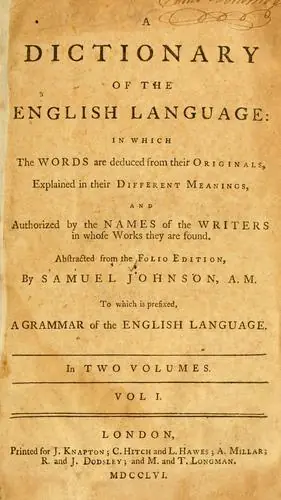
A dictionary of the English language
by Samuel Johnson · first published 1747
7mentions
1recommended by
7HN commenters
2014–2022first – last mentioned
14% recommend86% neutral
A dictionary with more than 40,000 entries which was a primary reference source for scholars and writers of the 18th and 19th century.
Affiliate links. As an Amazon Associate I earn from qualifying purchases.
One of my favorite works of literature is the preamble to A Dictionary of the English Language, by one of the first lexicographers, Samuel Johnson. Perhaps I'm so fond of it because I can beat his prose over the head of prescriptivists and Francophones in an argument, but whatever the reason, I…
on “Using the wrong dictionary” ↗…the Roud Folk Song Index, a database of 250,000 songs all researched and compiled by a former librarian in the 70s, as a labor of love (and scholarly dedication, I guess). And then Samuel Johnson's A Dictionary of the English Language, a dictionary researched and written by a single man. He thought it would take three years, ended up taking nine years. All the more impressive for the reckless confidence paid off by diligence. The…
on “Ask HN: Single-person creations that have stood the test of time?” ↗Reading from your second link, Samuel Johnson's Dictionary of the English Language: > ORDER. s [ordo, Lat.] 1. Method; regular disposition. 2. Established process. 3. Proper state. 4. Regularity; settled mode. 5. Mandate; precept; command. 6. Rule; regulation. 7. Regular government.…
on “What is the origin of “daemon” with regards to computing? (2011)” ↗…Shakespeare are an extreme example, being older than most works on the site. I'd prefer the original spelling, but for works of that age I can understand changing it. I'd set the publication of Johnson's "A Dictionary of the English Language" (1755) (or a few years later) as the cut-off point for spelling changes.
on “Translations of the Dao De Jing” ↗And has for a long time. The 1818 version of Johnson's "A Dictionary of the English Language" has "an unexpected legacy; any unexpected advantage", with no negative connotations. https://books.google.com/books?id=zsI_AQAAMAAJ&pg=PT1100&dq=... The original 1755 version only had "Fruit blown…
on “NSA Reports Improper Surveillance of Americans” ↗Samuel Johnson's first dictionary of the English Language, published in 1755, gave the definition of swan as “The ſwan is a large waterfowl, that has a long and very ſtranght neck, and is very white, excepting when it is young [...]”, Following your logic,…
…simple if you do a little studying on the history of language documentation between the 18th and 20th Centuries. Probably the most important, seminal dictionary was from Samuel Johnson. The two-volume Dictionary of the English Language was published in 1755. It was an incomplete catalogue, full of opinion and jokes (see the definition of "oats" at http://en.wikipedia.org/wiki/A_Dictionary_of_the_English_Lan...). But it was a big deal…
on “Using the wrong dictionary” ↗