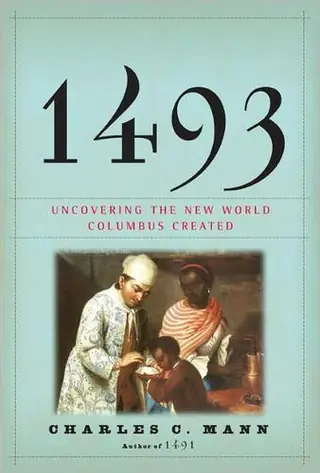
1493
by Charles C. Mann · first published 2011
65% recommend35% neutral
Why HN recommends it
Covers the Columbian Exchange, the flow of plants, animals, microbes and goods after 1492 and their wide effects. It is a well-informed history, worth reading for anyone interested in the topic.
Summarised by Claude from recommending comments
From the author of 1491 -- the best-selling study of the pre-Columbian Americas -- a deeply engaging new history of the most momentous biological event since the death of the dinosaurs. More than 200 million years ago, geological forces split apart the continents. Isolated from each other, the two halves of the world developed radically different suites of plants and animals. When Christopher Columbus set foot in the Americas, he ended that separation at a stroke. Driven by the economic goal of establishing trade with China, he accidentally set off an ecological convulsion as European vesse
Affiliate links. As an Amazon Associate I earn from qualifying purchases.
Mentions per year
What Hacker News says
Related books
 2009–2026
1491
Charles C. Mann
Recommended by 43 · mentioned by 6343 recommend · 63 mention43 recommend · 6343 recommend
 2019–2020
Augustus
Anthony Everitt, Alexander López Lobo
Recommended by 2 · mentioned by 22 recommend · 2 mention2 recommend · 22 recommend
 2014–2019
Ecological Imperialism
Alfred W. Crosby
Recommended by 1 · mentioned by 21 recommend · 2 mention1 recommend · 21 recommend
 2010–2024
King Rat
James Clavell
Recommended by 14 · mentioned by 1614 recommend · 16 mention14 recommend · 1614 recommend
 2018–2026
The Wizard and the Prophet
Charles C. Mann
Recommended by 28 · mentioned by 3328 recommend · 33 mention28 recommend · 3328 recommend
 2019–2026
Permanent Record
Edward Snowden
Recommended by 22 · mentioned by 5122 recommend · 51 mention22 recommend · 5122 recommend
I recently finished 1493: Uncovering the New World Columbus Created. http://www.amazon.com/1493-Uncovering-World-Columbus-Created... Highly recommended!
on “Discovery of 1,000-year-old Viking site in Canada could rewrite history” ↗1491 and 1493 are two great books by the same author, delving deep into those topics. I enjoyed every line, and there was a lot of them :-) https://www.amazon.com/1491-Revelations-Americas-Before-Colu... https://www.amazon.com/1493-Uncovering-World-Columbus-Create...
on “Native Intelligence” ↗The guano wars is also covered, along with a lot more, in _1493_ by Charles Mann. This tome looks at the reverberations of the Columbian exchange, and is well worth the read if you are interested in history.
on “The Soil Depletion Crisis: A tragic episode from the 19th century” ↗there's also the sequel, 1493, about the post-contact era: https://en.wikipedia.org/wiki/1493:_Uncovering_the_New_World... https://www.amazon.com/1493-Uncovering-World-Columbus-Create...
on “Indigenous civilizations are far older and more complex than history suggests” ↗…particular order the best ones I've read this year(so far) are: Children of the Nameless by Brandon Sanderson Augustus: The Life of Rome's First Emperor by Anthony Everitt King Rat by James Clavell 1493: Uncovering the New World Columbus Created by Charles C. Mann Clean Code: A Handbook of Agile Software Craftsmanship by Robert C. Martin The Elric Saga Part 1 by Michael Moorcock
on “Ask HN: Best books you've read in 2019?” ↗If you find this sort of thing interesting, then strong recommendation for "1493", by Charles C. Mann. A reference to 1492, the year that Columbus landed in the Western Hemisphere, this book is all about the Columbian Exchange. The effects of plant, animal, and microbial species…
on “How the Chili Pepper Conquered China” ↗As a European, after reading "1491" and "1493" by Charles C. Mann last year, I agree: I learned a lot from that book. I didn't realize there was such a treasure trove of world history there, and so many intricate links between these societies in…
on “Great Pyramid of Cholula” ↗…because it takes a long time to do it properly! Kudos for the perseverance and stamina! I hope I'll be able to return the favor one day by doing a similar thing of some of my favorite books ("1491", "1493", "Debt: the first 5,000 years", "Atlantide" (book by Renzo Piano and his son Carlo, only in Italian) etc).
on “If Sapiens were a blog post” ↗…Earle argued, led to 'typhoid, dysentery, and perhaps salt poisoning.' By January 1608, eight months after landfall, only thirty-eight [of the original 144] English were left alive." From Charles Mann's "1493", which is a fantastic read; it's full of satisfying connections between environmental and historical forces like the above.
on “Chesapeake Bay Impact Crater” ↗Forest agriculture like this is one of the things Mann spends a lot of pages on in 1491. Highly recommended, wish I'd read it sooner. 1493 is good too, if you like reading about immense human misery, and also, mostly, but not entirely, separately, a whole bunch about China.
on “Ancient Indigenous forest gardens still yield bounty 150 years later” ↗…from playing a part in the decimation of native populations to why slavery only took hold in some places to the difficulties of some Union offensives in the Civil War. Charles Mann wrote a great book, 1493, on the Colombian Exchange which I'd highly recommend. The introduction of malaria to the Americas is one underappreciated aspect of that he introduced me to.
on “Seven people have acquired malaria in the US. They’re the first in 20 years” ↗Mann's books ("1491" and "1493") are even better - great examples of longform journalism as history. They also update some of the facts in the article, since we've learned a lot more in the past decade.
on “Life in the Americas Before Columbus (2002)” ↗Nowadays most of my reading is online, I read about a paper book per week, like most of us. My fiction is mostly SF/Fantasy. My favorite non-fiction is history, entirely predictable. I just finished 1493 last night; it was excellent. Blitzkrieg: From the Rise of Hitler to the Fall of Dunkirk before that, also good, although Len Deighton is definitely opinionated. I read HN with an eye to suggestions,…
on “Alan Kay's reading list” ↗There's an awesome discussion of Potosí and its wider role in the first stages of globalization in Mann's book 1493.
on “Potosí: the mountain of silver that was the first global city” ↗…where civilization, that all too human disease, has not fully infected the earth.” The article doesn't contain many facts to support or refute this idea. For a lot of them, check out the books 1491 and 1493 by Charles Mann. Spoiler: the lands we think of as having been pristine prior to arrival by Europeans were in fact heavily manipulated and in some cases densely populated.
on “The Myth of a Wilderness Without Humans” ↗